AI TRADE
FRONTIER
Reading the next opportunities in AI trade
VOL. 01 · FIRST ISSUE
PUBLISHED & PRODUCED BY VIZERV
FIRST-ISSUE SPECIAL · CONNECT AI
Senior, junior and AI,
working as one team

ABOUT THE PUBLICATION
The publisher
VIZERV
AI trade webzine · First issue
From firms' experience
to the next opportunity
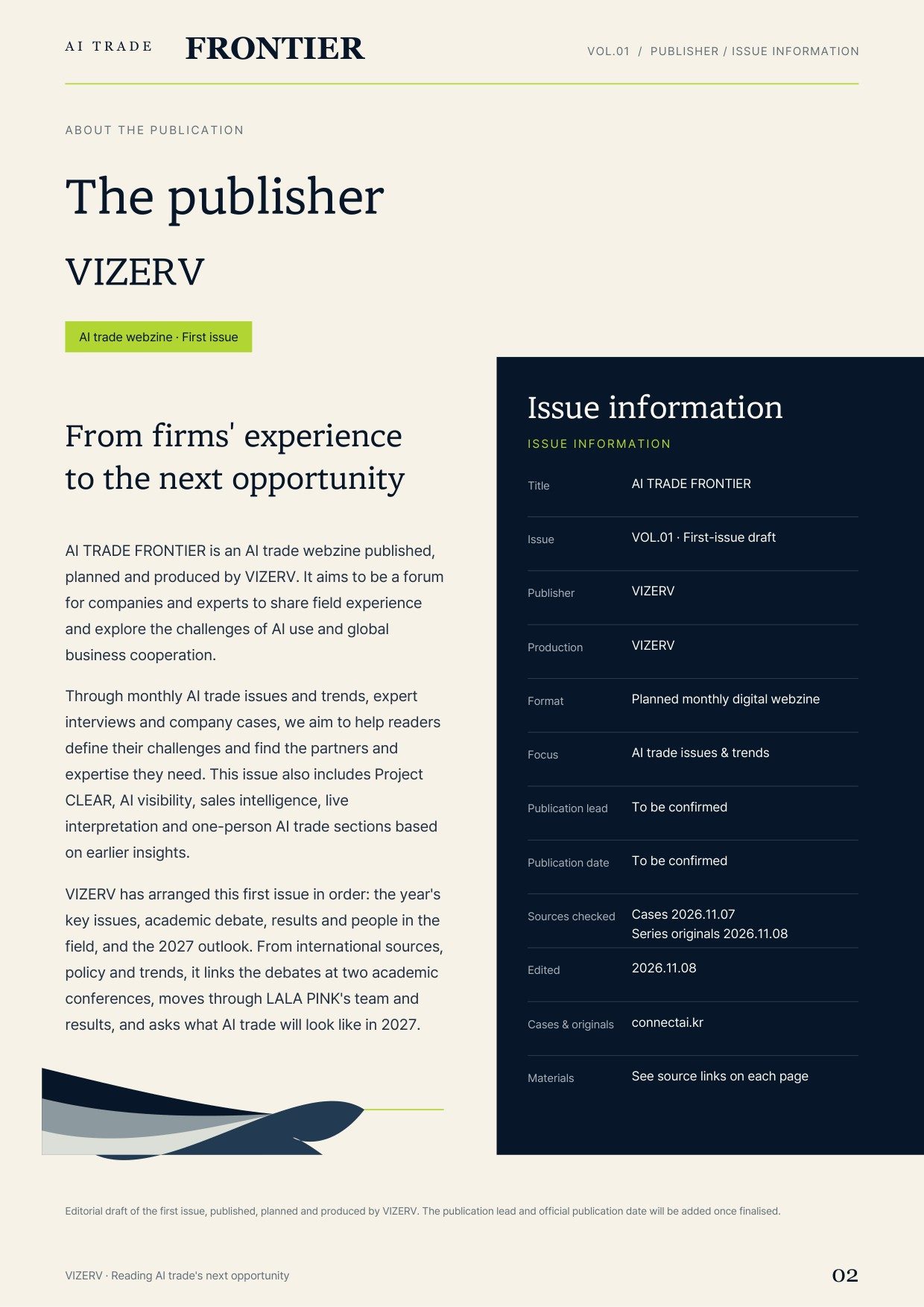
AI TRADE FRONTIER is an AI trade webzine published, planned and produced by VIZERV. It aims to be a forum for companies and experts to share field experience and explore the challenges of AI use and global business cooperation.
Through monthly AI trade issues and trends, expert interviews and company cases, we aim to help readers define their challenges and find the partners and expertise they need. This issue also includes Project CLEAR, AI visibility, sales intelligence, live interpretation and one-person AI trade sections based on earlier insights.
VIZERV has arranged this first issue in order: the year's key issues, academic debate, results and people in the field, and the 2027 outlook. From international sources, policy and trends, it links the debates at two academic conferences, moves through LALA PINK's team and results, and asks what AI trade will look like in 2027.
Issue information
ISSUE INFORMATION
- Title
- AI TRADE FRONTIER
- Issue
- VOL.01 · First-issue draft
- Publisher
- VIZERV
- Production
- VIZERV
- Format
- Planned monthly digital webzine
- Focus
- AI trade issues & trends
- Publication lead
- To be confirmed
- Publication date
- To be confirmed
- Sources checked
- Cases 2026.11.07
Series originals 2026.11.08 - Edited
- 2026.11.08
- Cases & originals
- connectai.kr
- Materials
- See source links on each page
Editorial draft of the first issue, published, planned and produced by VIZERV. The publication lead and official publication date will be added once finalised.
VOL.01 / THE FIRST ISSUE
CONTENTS
In this issue
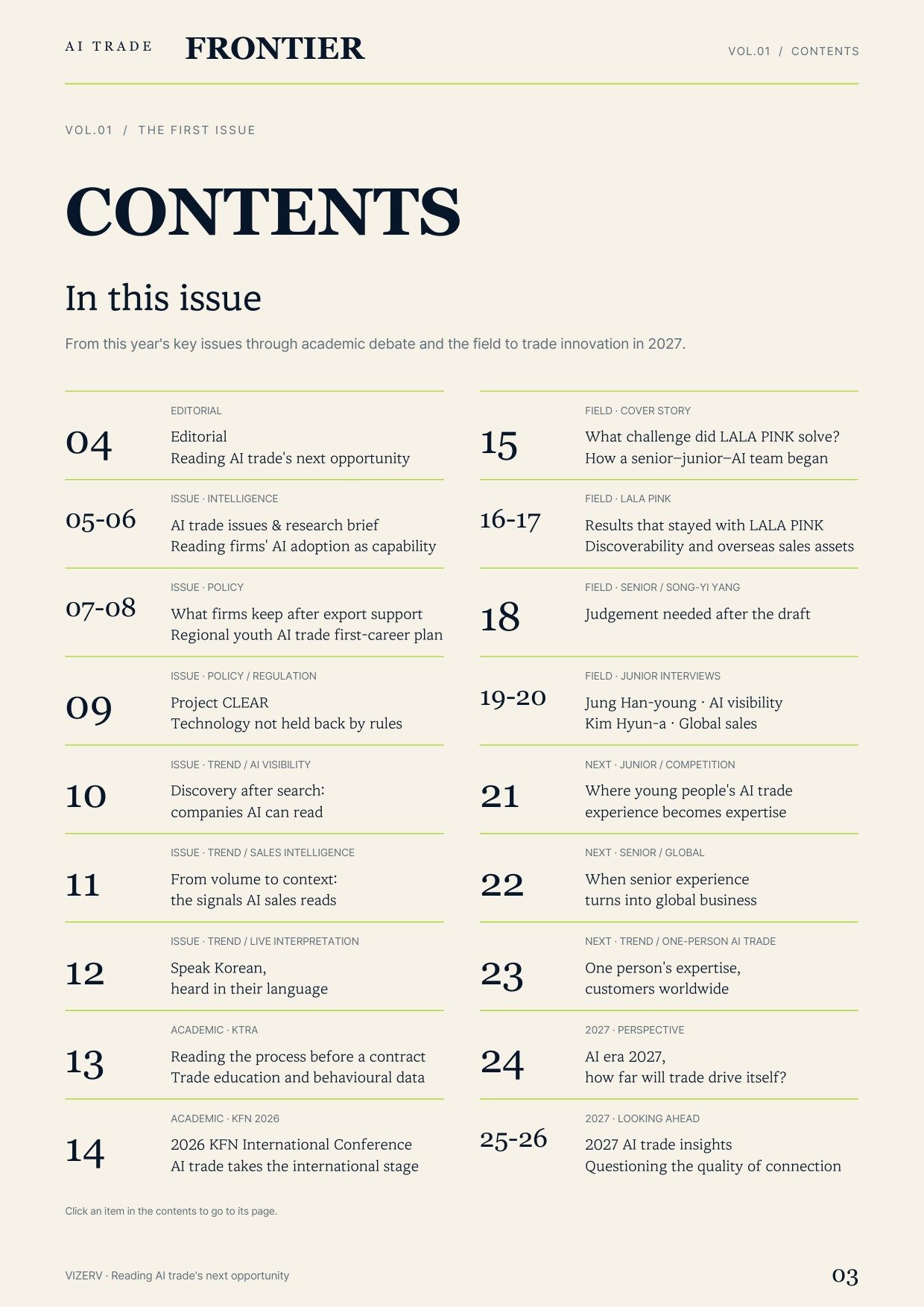
From this year's key issues through academic debate and the field to trade innovation in 2027.
- 04EDITORIALEditorial
Reading AI trade's next opportunity - 05-06ISSUE · INTELLIGENCEAI trade issues & research brief
Reading firms' AI adoption as capability - 07-08ISSUE · POLICYWhat firms keep after export support
Regional youth AI trade first-career plan - 09ISSUE · POLICY / REGULATIONProject CLEAR
Technology not held back by rules - 10ISSUE · TREND / AI VISIBILITYDiscovery after search:
companies AI can read - 11ISSUE · TREND / SALES INTELLIGENCEFrom volume to context:
the signals AI sales reads - 12ISSUE · TREND / LIVE INTERPRETATIONSpeak Korean,
heard in their language - 13ACADEMIC · KTRAReading the process before a contract
Trade education and behavioural data - 14ACADEMIC · KFN 20262026 KFN International Conference
AI trade takes the international stage - 15FIELD · COVER STORYWhat challenge did LALA PINK solve?
How a senior–junior–AI team began - 16-17FIELD · LALA PINKResults that stayed with LALA PINK
Discoverability and overseas sales assets - 18FIELD · SENIOR / SONG-YI YANGJudgement needed after the draft
- 19-20FIELD · JUNIOR INTERVIEWSJung Han-young · AI visibility
Kim Hyun-a · Global sales - 21NEXT · JUNIOR / COMPETITIONWhere young people's AI trade
experience becomes expertise - 22NEXT · SENIOR / GLOBALWhen senior experience
turns into global business - 23NEXT · TREND / ONE-PERSON AI TRADEOne person's expertise,
customers worldwide - 242027 · PERSPECTIVEAI era 2027,
how far will trade drive itself? - 25-262027 · LOOKING AHEAD2027 AI trade insights
Questioning the quality of connection
Click an item in the contents to go to its page.
EDITORIAL / THE FIRST ISSUE
Reading AI trade's
next opportunity
From this year's issues through academic debate and the field,
a first issue that leads to innovation in 2027.
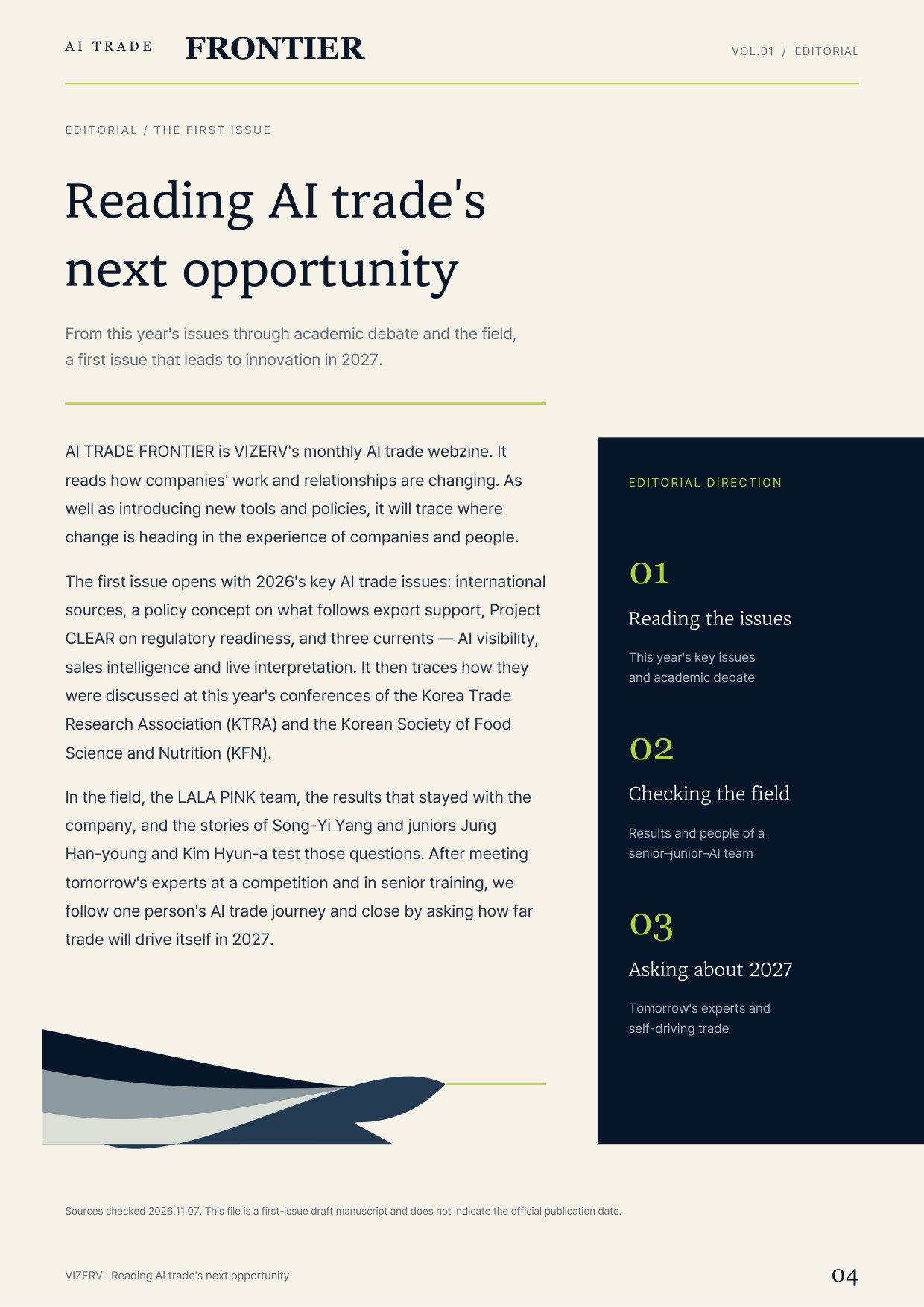
AI TRADE FRONTIER is VIZERV's monthly AI trade webzine. It reads how companies' work and relationships are changing. As well as introducing new tools and policies, it will trace where change is heading in the experience of companies and people.
The first issue opens with 2026's key AI trade issues: international sources, a policy concept on what follows export support, Project CLEAR on regulatory readiness, and three currents — AI visibility, sales intelligence and live interpretation. It then traces how they were discussed at this year's conferences of the Korea Trade Research Association (KTRA) and the Korean Society of Food Science and Nutrition (KFN).
In the field, the LALA PINK team, the results that stayed with the company, and the stories of Song-Yi Yang and juniors Jung Han-young and Kim Hyun-a test those questions. After meeting tomorrow's experts at a competition and in senior training, we follow one person's AI trade journey and close by asking how far trade will drive itself in 2027.
EDITORIAL DIRECTION
01
Reading the issues
This year's key issues
and academic debate
02
Checking the field
Results and people of a
senior–junior–AI team
03
Asking about 2027
Tomorrow's experts and
self-driving trade
Sources checked 2026.11.07. This file is a first-issue draft manuscript and does not indicate the official publication date.
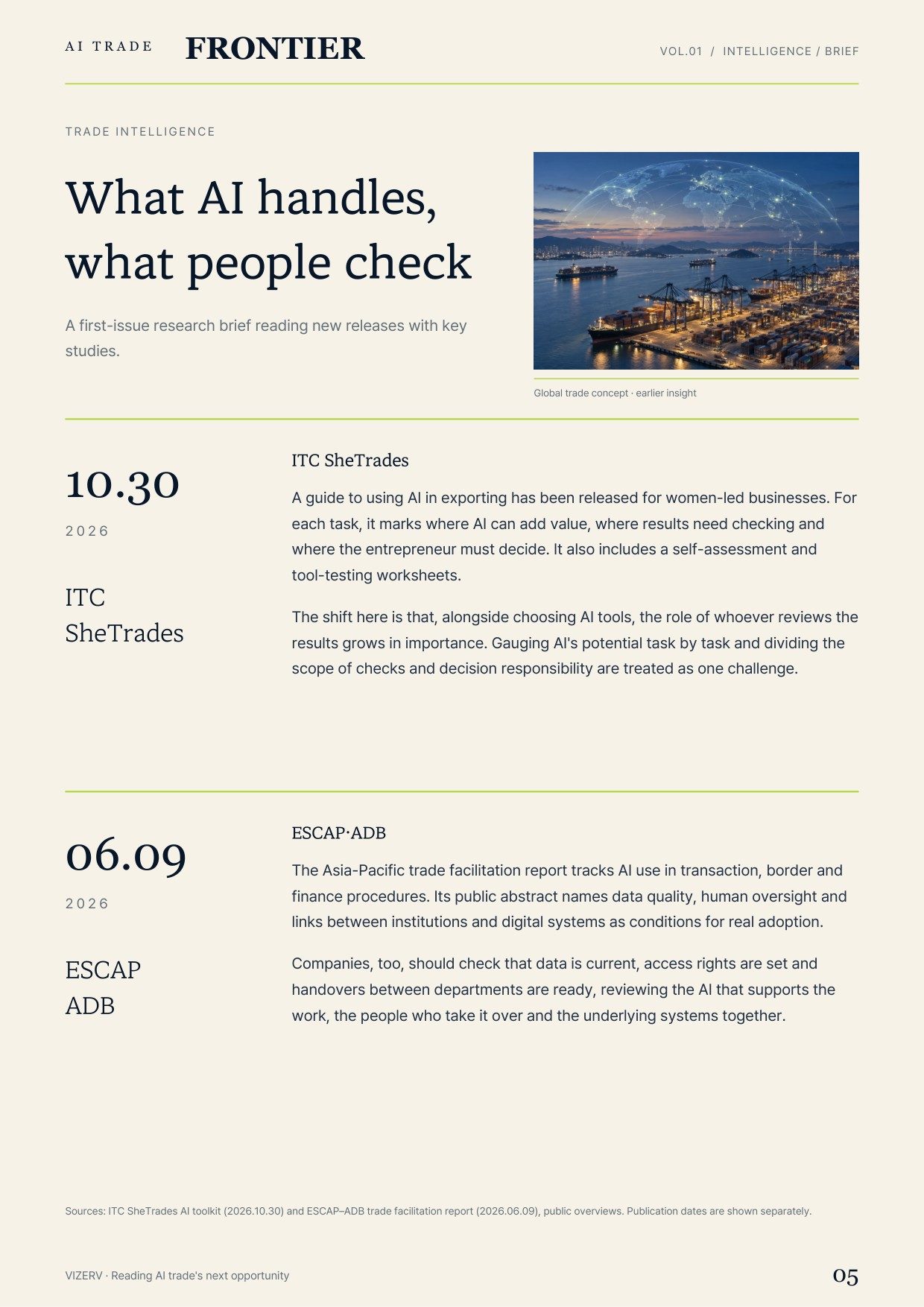
TRADE INTELLIGENCE
What AI handles,
what people check
A first-issue research brief reading new releases with key studies.

2026.10.30
ITC SheTrades
A guide to using AI in exporting has been released for women-led businesses. For each task, it marks where AI can add value, where results need checking and where the entrepreneur must decide. It also includes a self-assessment and tool-testing worksheets.
The shift here is that, alongside choosing AI tools, the role of whoever reviews the results grows in importance. Gauging AI's potential task by task and dividing the scope of checks and decision responsibility are treated as one challenge.
2026.06.09
ESCAP·ADB
The Asia-Pacific trade facilitation report tracks AI use in transaction, border and finance procedures. Its public abstract names data quality, human oversight and links between institutions and digital systems as conditions for real adoption.
Companies, too, should check that data is current, access rights are set and handovers between departments are ready, reviewing the AI that supports the work, the people who take it over and the underlying systems together.
Sources: ITC SheTrades AI toolkit (2026.10.30) and ESCAP–ADB trade facilitation report (2026.06.09), public overviews. Publication dates are shown separately.
READING THE SIGNALS
Reading firms' AI trade adoption
as a capability question
Past surveys, too, must be read for their timing and scope.
ICC–WTO · 11 December 2025
The business survey overview published by the ICC and WTO covers AI's potential in trade alongside adoption gaps. Barriers cited include lack of capability, trust and security concerns, and regulatory fragmentation. The survey was published in 2025; these are not new figures for this month.
Read alongside this issue's two job-role cases, the key is the role of people. Tool output is usable in real work only if someone organises company information, interprets buyers' questions and carries follow-up forward.
READING THE SHIFT
01
Trust in information
Is the explanation evidenced?
02
Human judgement
Reading the context of the work
03
Lasting relationships
From one action to the next talk
Three lenses on competitiveness
Companies' AI use can be read through three lenses — trust in information, human judgement and lasting relationships: what a firm knows, who interprets it, and whether one action leads to the next task. This is not a forecast extending the study's statistical findings but the editors' reading of this issue's cases.
Reading differences after adoption
With the same technology, use still varies with knowledge of products and customers, collaborative experience and ways of talking. So beyond the scale of adoption, we should look at the data and practical skills a company retains. The next policy concept asks how to link these to regional youth and companies' challenges.
Sources: ICC–WTO business survey (2025.12.11), public overview. The three lenses are the editors' commentary on the source and this issue's cases.
POLICY / AFTER SUPPORT
After export support ends,
what should companies keep?
AI trade's next task is to leave companies with reusable data and ways of working,
and the people to carry them on.
Overseas sales beyond the meeting
After overseas trade fairs and buyer meetings come replies to send, product material to improve, and samples and quotes to prepare. To avoid re-explaining earlier talks at the next meeting, firms also need a record of who was interested in what and which terms were confirmed. That is why AI trade design must cover this follow-up work too.
The assets a company can keep using after support ends are concrete: material on products, certifications and trade terms; the grounds for vetting buyers; and records of meetings and next steps. Access rights and handover methods are needed too, so work can continue when staff change.
Linking training to real company tasks
CONNECT AI's proposed Regional Youth AI Trade First Career Project (working title) is a joint private-sector pilot concept linking training and workplaces to address this. It sets out X+AI capability training, then market research, buyer review, proposals and follow-up for regional firms, with company sign-off and proof of results.
The policy keynote proposes choosing regions by local demand and university and firm readiness, then expanding nationwide in stages after trials and evaluation. Trial scale, duration and budget would be set after reviewing demand, unit costs and support and spending criteria. The aim: company-verified work experience for youth, lasting export capability for firms.
INFORMATION
Data
HISTORY
Records
PEOPLE
People
Basis: Regional youth AI trade pilot proposal letter, pp. 1–2; National Export AX Policy Keynote (2026.10.20), sections 3, 5, 6 and 8. A private-sector policy proposal; participating regions, institutions and scale are to be set after consultation and review.
NATIONAL DIRECTION / REGIONAL PILOTS
Linking regional business challenges
to young people's first careers
A nationwide roll-out plan selecting regions by local demand and university and company readiness.
Nationwide roll-out plan built on regional specialist industries
Roll-out direction
Nationwide,
in stages
Regions and institutions to be confirmed after consultation
Region selection criteria
Local demand and
university–firm readiness
Trial scale, duration and budget to be set after checking
demand, unit costs and support and spending criteria
Dividing roles, checking results
Implementation also requires each participant's role to be defined. The proposal sets out a partnership in which universities and youth bodies handle selection and training, companies provide tasks and sign off results, and CONNECT AI supports tools, training, company matching and results management. Expert review is linked to handover to company staff, and external messages go out only after company approval.
Evaluation should separate course completion, task completion, paid placement, hiring and job retention. Buyer connections likewise need separate records for replies, meetings, samples and quotes, and actual contracts. The proposal's test is to compare time and cost, including review and rework, for the same products and markets at equal workload and quality, and to find improvements through independent evaluation. Read this policy concept apart from the issue's field collaboration case. The task ahead is confirming what stayed with companies and whether it carried into further work.
From market entry conditions to ways of working
Having weighed what to leave with companies, we turn to market entry and how companies work.
First regulation, then AI visibility, sales intelligence and live interpretation.
Basis: National Export AX Policy Keynote (2026.10.20), sections 6 and 8 and presentation notes; linked policy proposal, item 5. Participating regions, institutions, scale and duration are unconfirmed proposals.
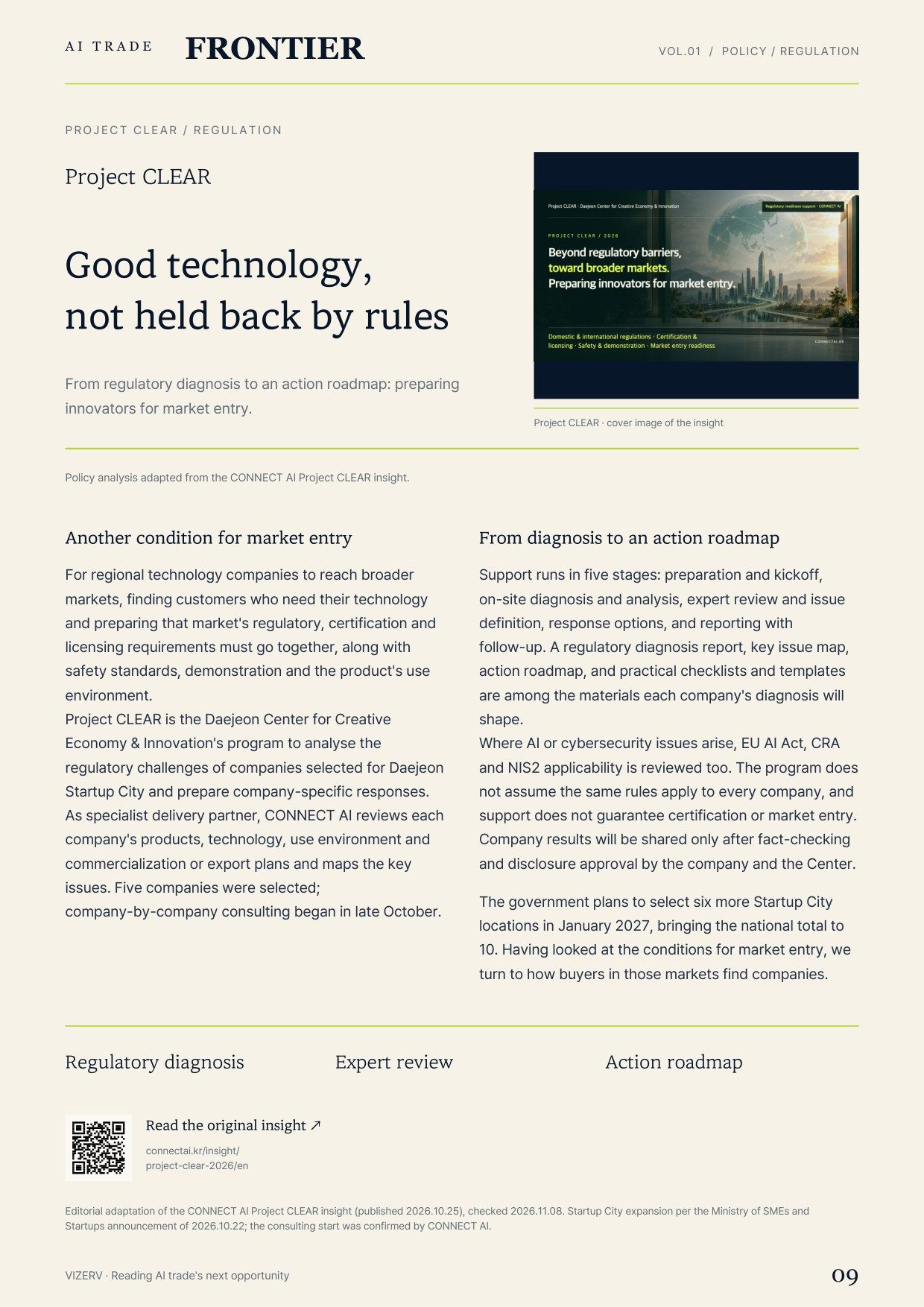
PROJECT CLEAR / REGULATION
Project CLEAR
Good technology,
not held back by rules
From regulatory diagnosis to an action roadmap: preparing innovators for market entry.

Policy analysis adapted from the CONNECT AI Project CLEAR insight.
Another condition for market entry
For regional technology companies to reach broader markets, finding customers who need their technology and preparing that market's regulatory, certification and licensing requirements must go together, along with safety standards, demonstration and the product's use environment.
Project CLEAR is the Daejeon Center for Creative Economy & Innovation's program to analyse the regulatory challenges of companies selected for Daejeon Startup City and prepare company-specific responses. As specialist delivery partner, CONNECT AI reviews each company's products, technology, use environment and commercialization or export plans and maps the key issues. Five companies were selected; company-by-company consulting began in late October.
From diagnosis to an action roadmap
Support runs in five stages: preparation and kickoff, on-site diagnosis and analysis, expert review and issue definition, response options, and reporting with follow-up. A regulatory diagnosis report, key issue map, action roadmap, and practical checklists and templates are among the materials each company's diagnosis will shape.
Where AI or cybersecurity issues arise, EU AI Act, CRA and NIS2 applicability is reviewed too. The program does not assume the same rules apply to every company, and support does not guarantee certification or market entry. Company results will be shared only after fact-checking and disclosure approval by the company and the Center.
The government plans to select six more Startup City locations in January 2027, bringing the national total to 10. Having looked at the conditions for market entry, we turn to how buyers in those markets find companies.
Regulatory diagnosis
Expert review
Action roadmap
Read the original insight ↗connectai.kr/insight/project-clear-2026/en
Editorial adaptation of the CONNECT AI Project CLEAR insight (published 2026.10.25), checked 2026.11.08. Startup City expansion per the Ministry of SMEs and Startups announcement of 2026.10.22; the consulting start was confirmed by CONNECT AI.
AI VISIBILITY / PERSPECTIVE
AI visibility
Discovery after search:
companies AI can read
From promotional content to answers for buyers' questions.
Trend analysis adapted from the AI visibility insight.
The rise of nameless queries
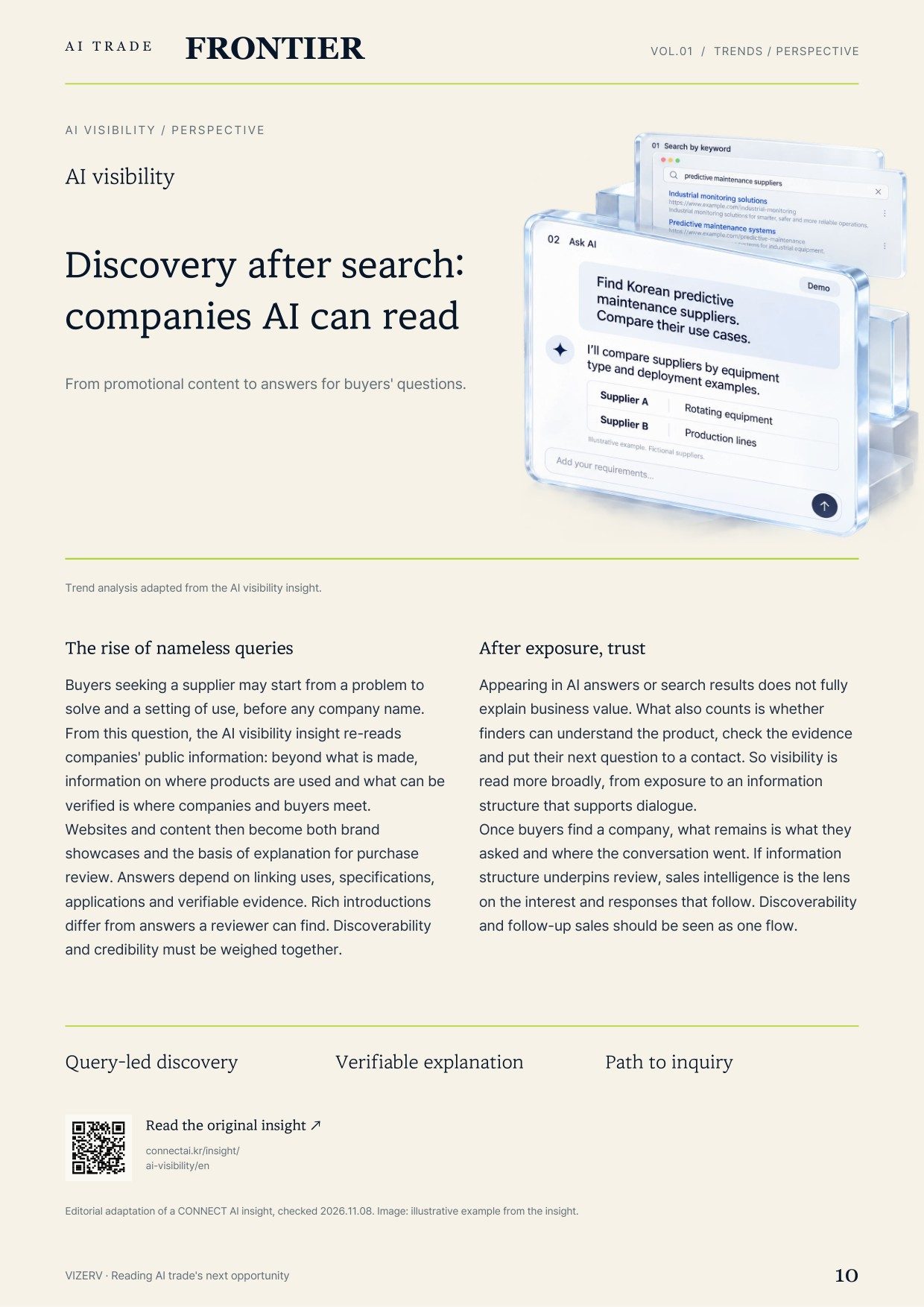
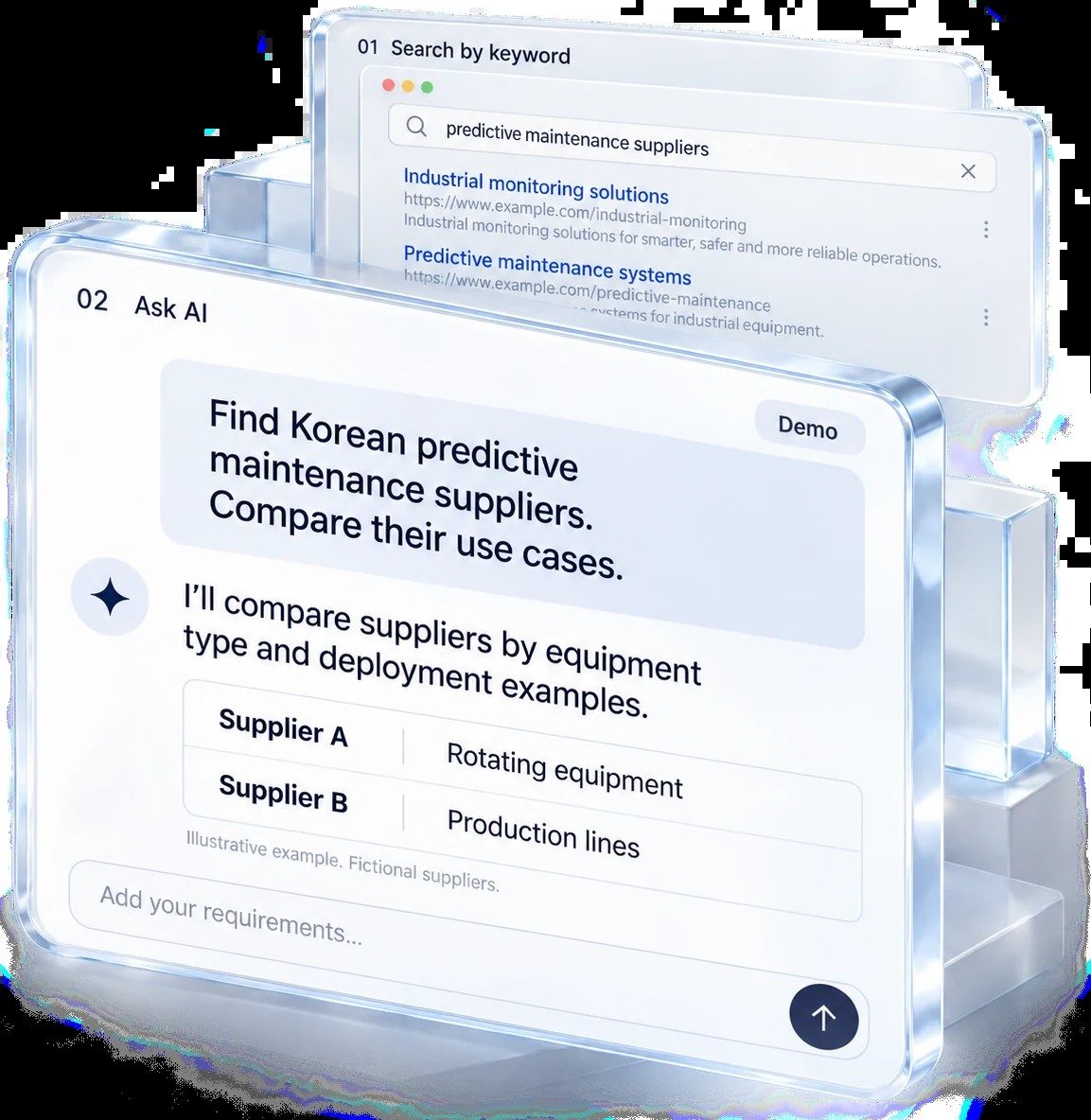
Buyers seeking a supplier may start from a problem to solve and a setting of use, before any company name. From this question, the AI visibility insight re-reads companies' public information: beyond what is made, information on where products are used and what can be verified is where companies and buyers meet.
Websites and content then become both brand showcases and the basis of explanation for purchase review. Answers depend on linking uses, specifications, applications and verifiable evidence. Rich introductions differ from answers a reviewer can find. Discoverability and credibility must be weighed together.
After exposure, trust
Appearing in AI answers or search results does not fully explain business value. What also counts is whether finders can understand the product, check the evidence and put their next question to a contact. So visibility is read more broadly, from exposure to an information structure that supports dialogue.
Once buyers find a company, what remains is what they asked and where the conversation went. If information structure underpins review, sales intelligence is the lens on the interest and responses that follow. Discoverability and follow-up sales should be seen as one flow.
Query-led discovery
Verifiable explanation
Path to inquiry
Read the original insight ↗connectai.kr/insight/ai-visibility/en
Editorial adaptation of a CONNECT AI insight, checked 2026.11.08. Image: illustrative example from the insight.
SALES INTELLIGENCE / PERSPECTIVE
Sales intelligence
From volume to context:
the signals AI sales reads
Beyond reach: what we understand and how talks continue.

Trend analysis adapted from the sales intelligence trilogy.
Reading behind the numbers
In overseas sales, sends and opens are records of activity; actual replies or consultations record a different stage. The intriguing question raised by the earlier sales intelligence insights is the context in which these different signals are read. That someone viewed your material can be a cue to start a conversation, but on its own it does not mean intent to buy or a likely deal.
When AI summarises large volumes of material and drafts messages, speed of content production alone can hardly explain the difference. Signals gain meaning only when read together with the other company's industry, products and previously confirmed requests. The shift this series traces is that the value of sales may extend from sending volume to the ability to interpret context.
The next conversation gives metrics meaning
Observed behaviour, the salesperson's interpretation and responses confirmed directly with the other side sit at different levels. The editors' reading is that, as automation grows, the role of people who understand this difference may become more defined: connecting information scattered across touchpoints, separating out what is still unknown, and judging which questions the next conversation needs.
Once signals are read, the conversation with the buyer remains. Next, we look at live interpretation meetings, which aim to lower the language barrier in front of that conversation.
Interest signals
Reading context
Ongoing dialogue
Read the original insight ↗connectai.kr/insight/sales-intelligence-1/en
Editorial adaptation of CONNECT AI insights, checked 2026.11.08.
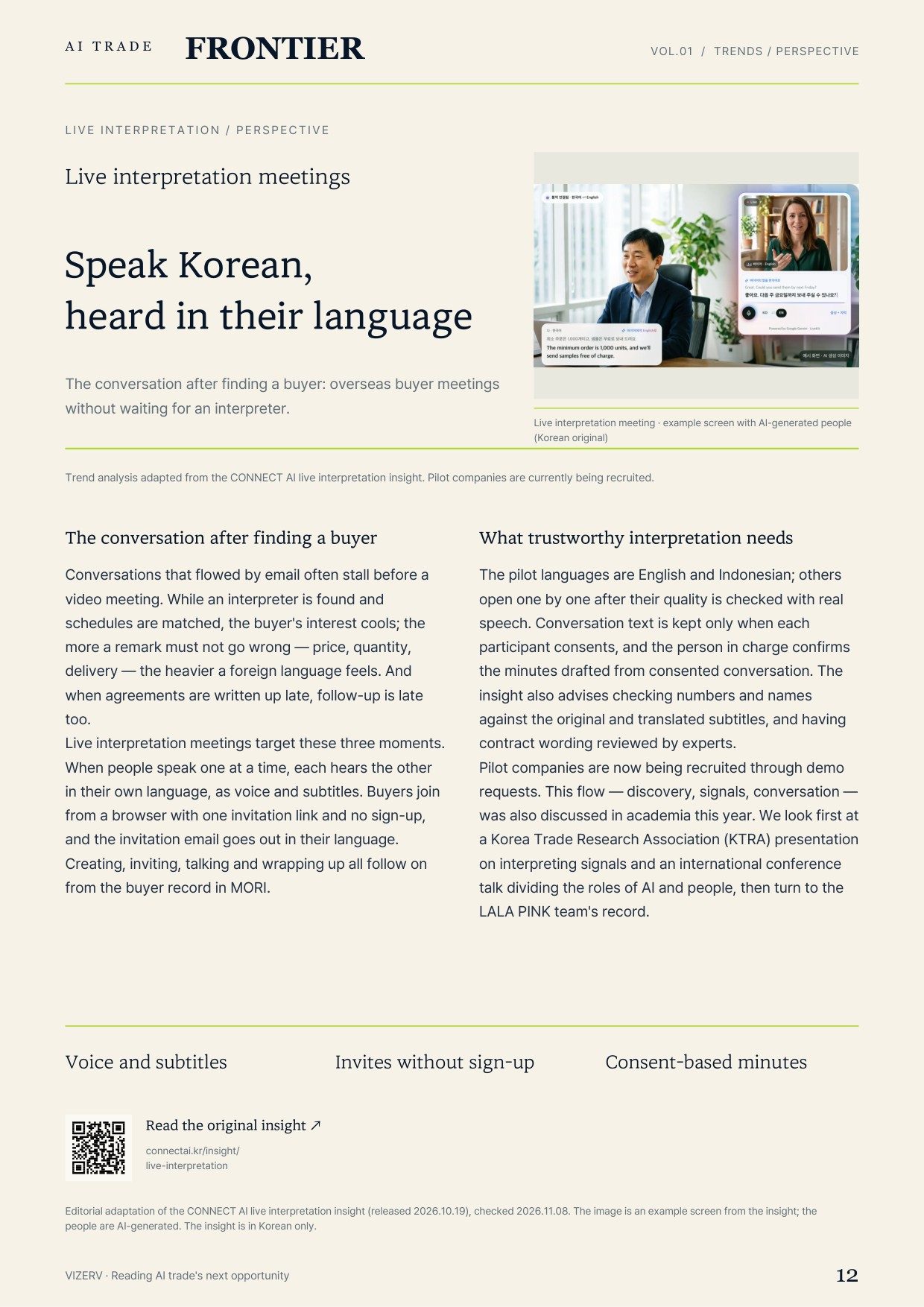
LIVE INTERPRETATION / PERSPECTIVE
Live interpretation meetings
Speak Korean,
heard in their language
The conversation after finding a buyer: overseas buyer meetings without waiting for an interpreter.
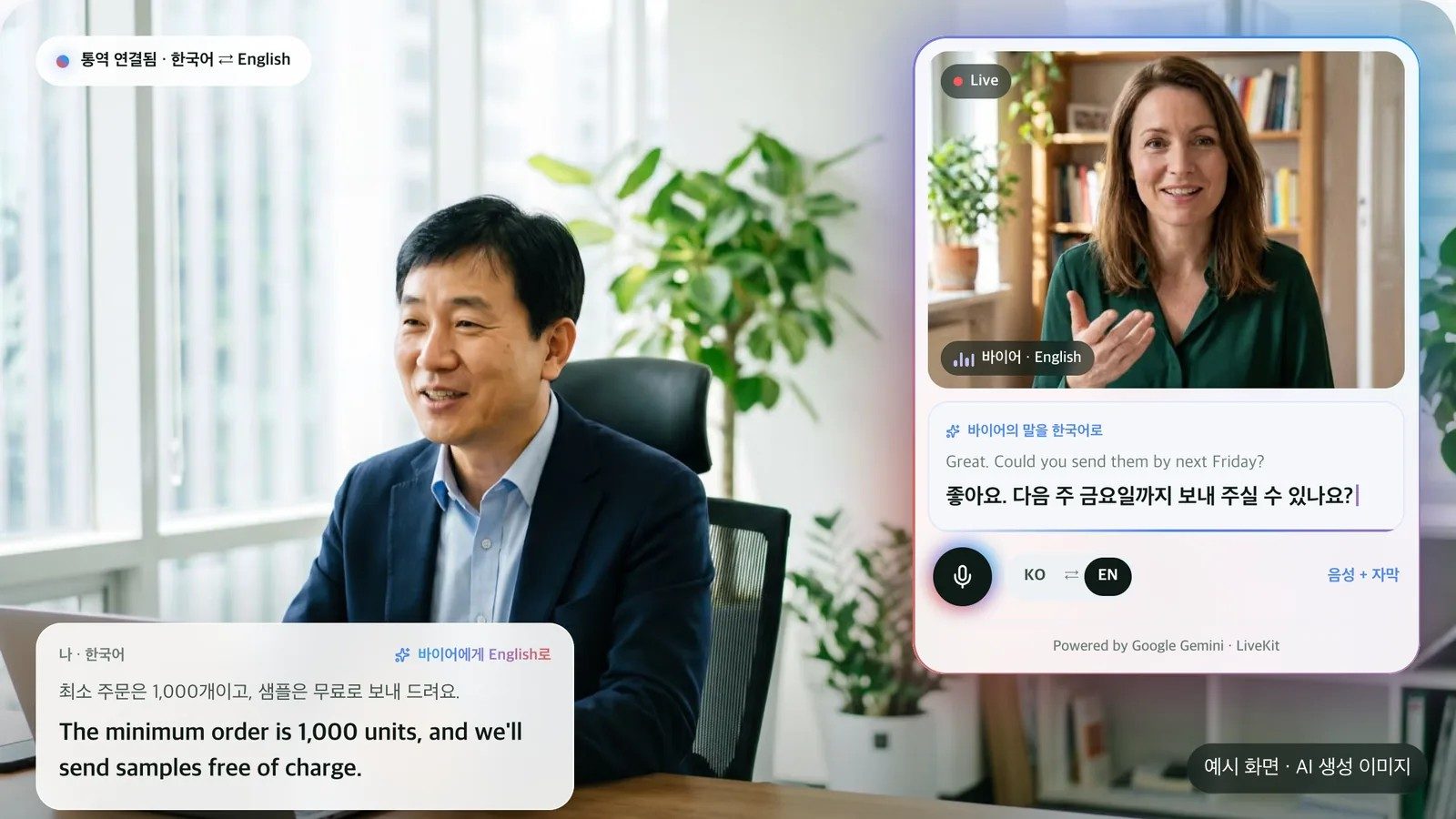
Trend analysis adapted from the CONNECT AI live interpretation insight. Pilot companies are currently being recruited.
The conversation after finding a buyer
Conversations that flowed by email often stall before a video meeting. While an interpreter is found and schedules are matched, the buyer's interest cools; the more a remark must not go wrong — price, quantity, delivery — the heavier a foreign language feels. And when agreements are written up late, follow-up is late too.
Live interpretation meetings target these three moments. When people speak one at a time, each hears the other in their own language, as voice and subtitles. Buyers join from a browser with one invitation link and no sign-up, and the invitation email goes out in their language. Creating, inviting, talking and wrapping up all follow on from the buyer record in MORI.
What trustworthy interpretation needs
The pilot languages are English and Indonesian; others open one by one after their quality is checked with real speech. Conversation text is kept only when each participant consents, and the person in charge confirms the minutes drafted from consented conversation. The insight also advises checking numbers and names against the original and translated subtitles, and having contract wording reviewed by experts.
Pilot companies are now being recruited through demo requests. This flow — discovery, signals, conversation — was also discussed in academia this year. We look first at a Korea Trade Research Association (KTRA) presentation on interpreting signals and an international conference talk dividing the roles of AI and people, then turn to the LALA PINK team's record.
Voice and subtitles
Invites without sign-up
Consent-based minutes
Read the original insight ↗connectai.kr/insight/live-interpretation
Editorial adaptation of the CONNECT AI live interpretation insight (released 2026.10.19), checked 2026.11.08. The image is an example screen from the insight; the people are AI-generated. The insight is in Korean only.
ACADEMIC / KTRA
Reading the process before a contract
Trade education and behavioural data
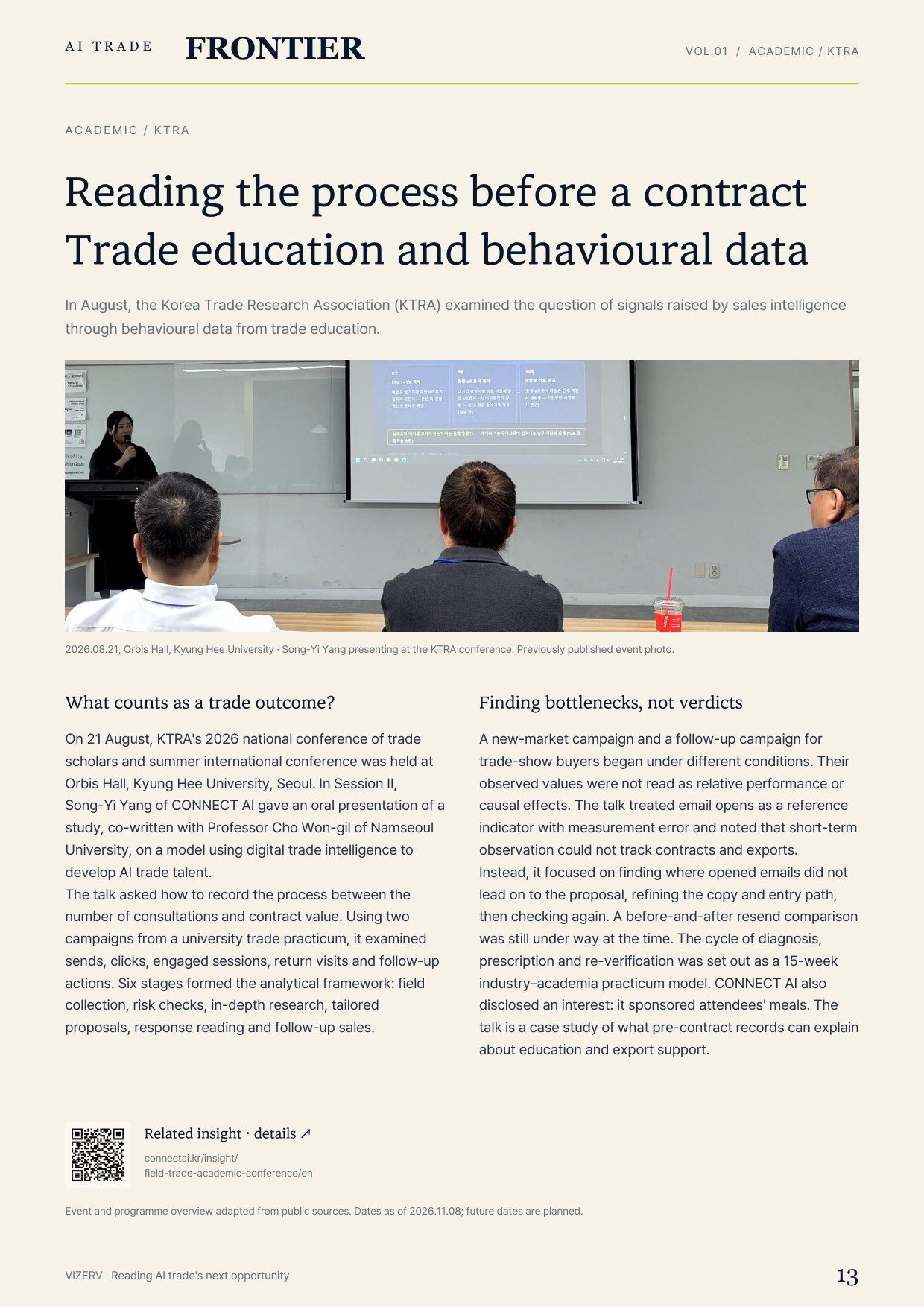
In August, the Korea Trade Research Association (KTRA) examined the question of signals raised by sales intelligence through behavioural data from trade education.
What counts as a trade outcome?
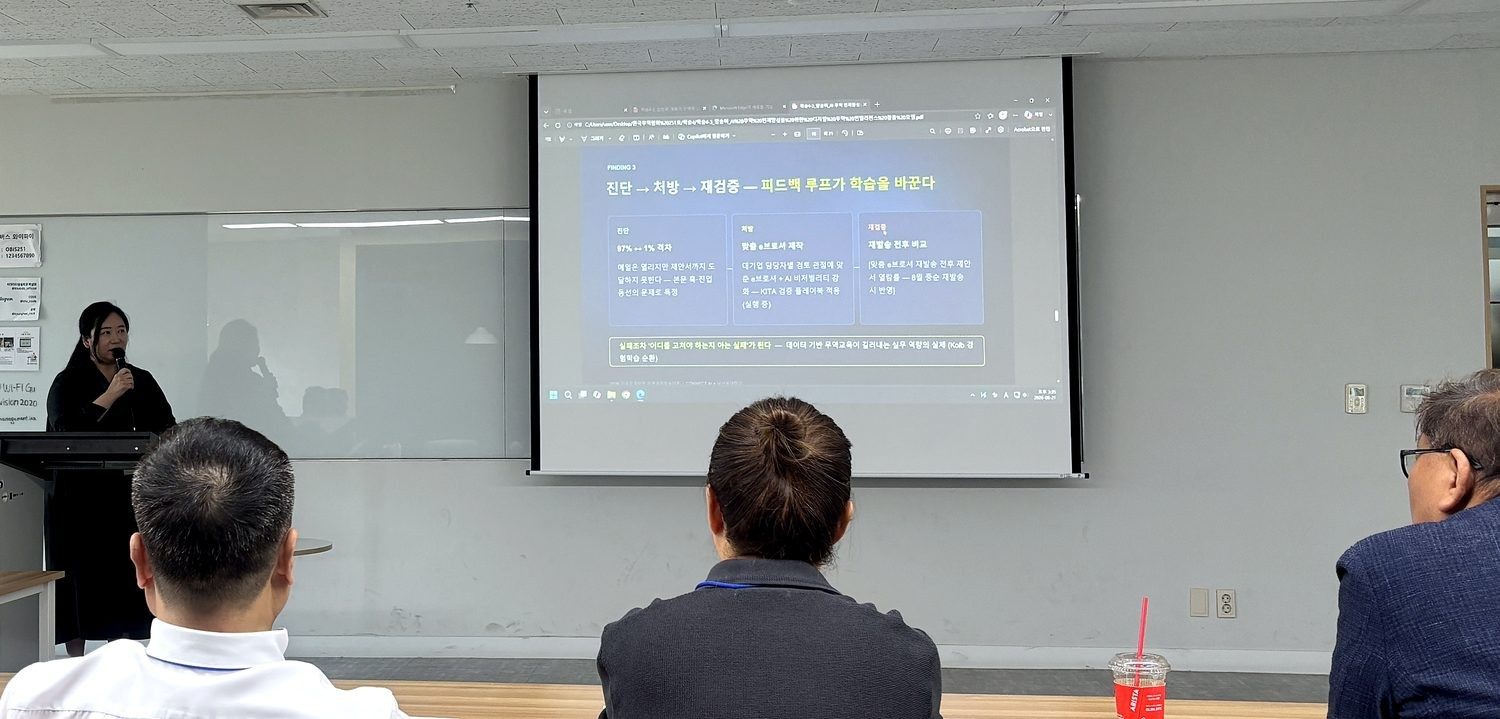
On 21 August, KTRA's 2026 national conference of trade scholars and summer international conference was held at Orbis Hall, Kyung Hee University, Seoul. In Session II, Song-Yi Yang of CONNECT AI gave an oral presentation of a study, co-written with Professor Cho Won-gil of Namseoul University, on a model using digital trade intelligence to develop AI trade talent.
The talk asked how to record the process between the number of consultations and contract value. Using two campaigns from a university trade practicum, it examined sends, clicks, engaged sessions, return visits and follow-up actions. Six stages formed the analytical framework: field collection, risk checks, in-depth research, tailored proposals, response reading and follow-up sales.
Finding bottlenecks, not verdicts
A new-market campaign and a follow-up campaign for trade-show buyers began under different conditions. Their observed values were not read as relative performance or causal effects. The talk treated email opens as a reference indicator with measurement error and noted that short-term observation could not track contracts and exports.
Instead, it focused on finding where opened emails did not lead on to the proposal, refining the copy and entry path, then checking again. A before-and-after resend comparison was still under way at the time. The cycle of diagnosis, prescription and re-verification was set out as a 15-week industry–academia practicum model. CONNECT AI also disclosed an interest: it sponsored attendees' meals. The talk is a case study of what pre-contract records can explain about education and export support.
Related insight · details ↗connectai.kr/insight/field-trade-academic-conference/en
Event and programme overview adapted from public sources. Dates as of 2026.11.08; future dates are planned.
2026 KFN INTERNATIONAL CONFERENCE
2026 KFN International Conference
AI trade takes the international stage
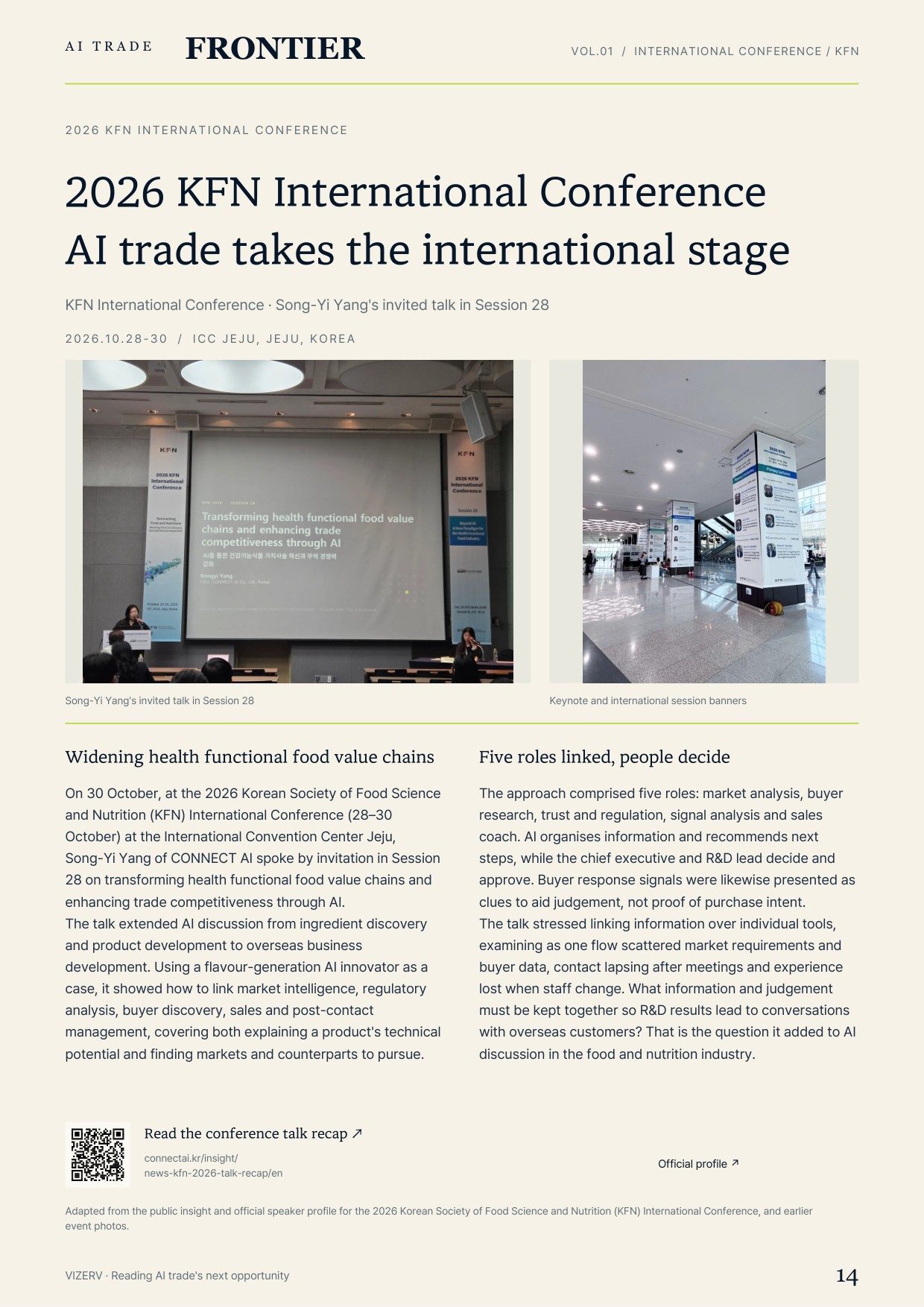
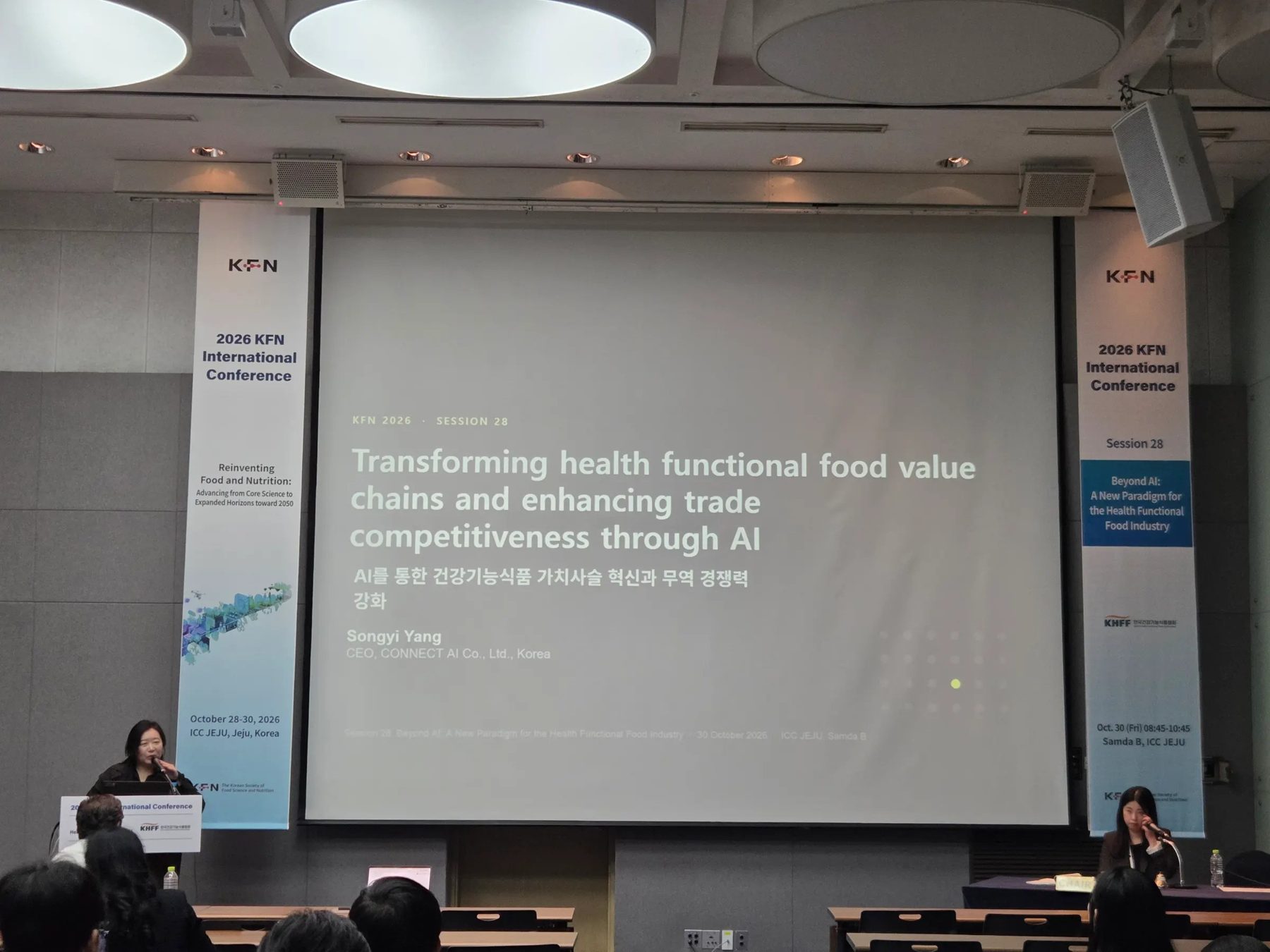
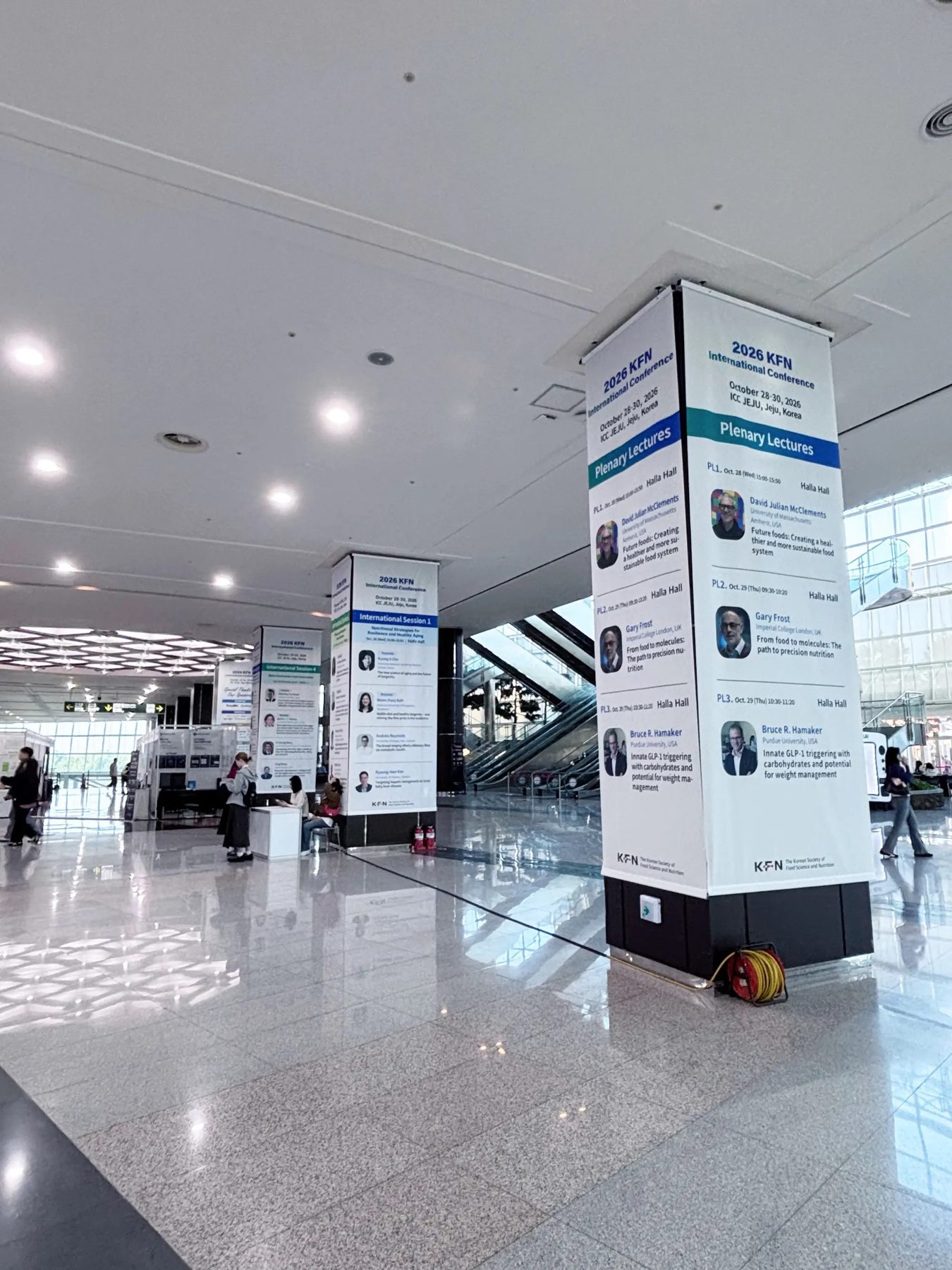
KFN International Conference · Song-Yi Yang's invited talk in Session 28
2026.10.28-30 / ICC JEJU, JEJU, KOREA
Widening health functional food value chains
On 30 October, at the 2026 Korean Society of Food Science and Nutrition (KFN) International Conference (28–30 October) at the International Convention Center Jeju, Song-Yi Yang of CONNECT AI spoke by invitation in Session 28 on transforming health functional food value chains and enhancing trade competitiveness through AI.
The talk extended AI discussion from ingredient discovery and product development to overseas business development. Using a flavour-generation AI innovator as a case, it showed how to link market intelligence, regulatory analysis, buyer discovery, sales and post-contact management, covering both explaining a product's technical potential and finding markets and counterparts to pursue.
Five roles linked, people decide
The approach comprised five roles: market analysis, buyer research, trust and regulation, signal analysis and sales coach. AI organises information and recommends next steps, while the chief executive and R&D lead decide and approve. Buyer response signals were likewise presented as clues to aid judgement, not proof of purchase intent.
The talk stressed linking information over individual tools, examining as one flow scattered market requirements and buyer data, contact lapsing after meetings and experience lost when staff change. What information and judgement must be kept together so R&D results lead to conversations with overseas customers? That is the question it added to AI discussion in the food and nutrition industry.
Read the conference talk recap ↗connectai.kr/insight/news-kfn-2026-talk-recap/en
Adapted from the public insight and official speaker profile for the 2026 Korean Society of Food Science and Nutrition (KFN) International Conference, and earlier event photos.
LALA PINK / THE TEAM
Senior, junior and AI,
working as one team
Academia's questions, tested in the field.
A field case: senior, junior and AI together tackle LALA PINK's overseas business task.
LALA PINK is a beauty brand that introduces melanin-care products and training programmes overseas. As a trade show in Poland prompted it to widen its overseas reach, it needed both information to help buyers understand the company and sales targets to contact first.
Senior expert Song-Yi Yang and two junior experts shared the work. Jung Han-young built the company's explanatory base through the website, FAQ and AI videos; Kim Hyun-a built sales assets through buyer discovery, outreach and follow-up. AI supported analysis and message drafts, and MORI the management of communication history and response records.
SENIOR EXPERT
Song-Yi Yang
Senior expert, linking
career and expertise
AI VISIBILITY
Jung Han-young
Groundwork for discovery
in search, AI and video
GLOBAL SALES
Kim Hyun-a
Buyer search, contact, follow-up;
sales history built up in-house
One task, two outcomes
The team's contribution shows in two distinct outcomes: company information found in search, AI and video, and buyer assets to carry into the next round of sales. The next two pages present these outcomes; we then look at how each person did the work, in terms of people and roles.
Basis: Kim Hyun-a's final report pp. 1, 4, 6, 28, 33; Jung Han-young's final report pp. 4–17; Kim Hyun-a's earlier interview and Jung Han-young's earlier interview. The team of one senior and two juniors, and Song-Yi Yang's part as senior expert, are details confirmed by the project team.
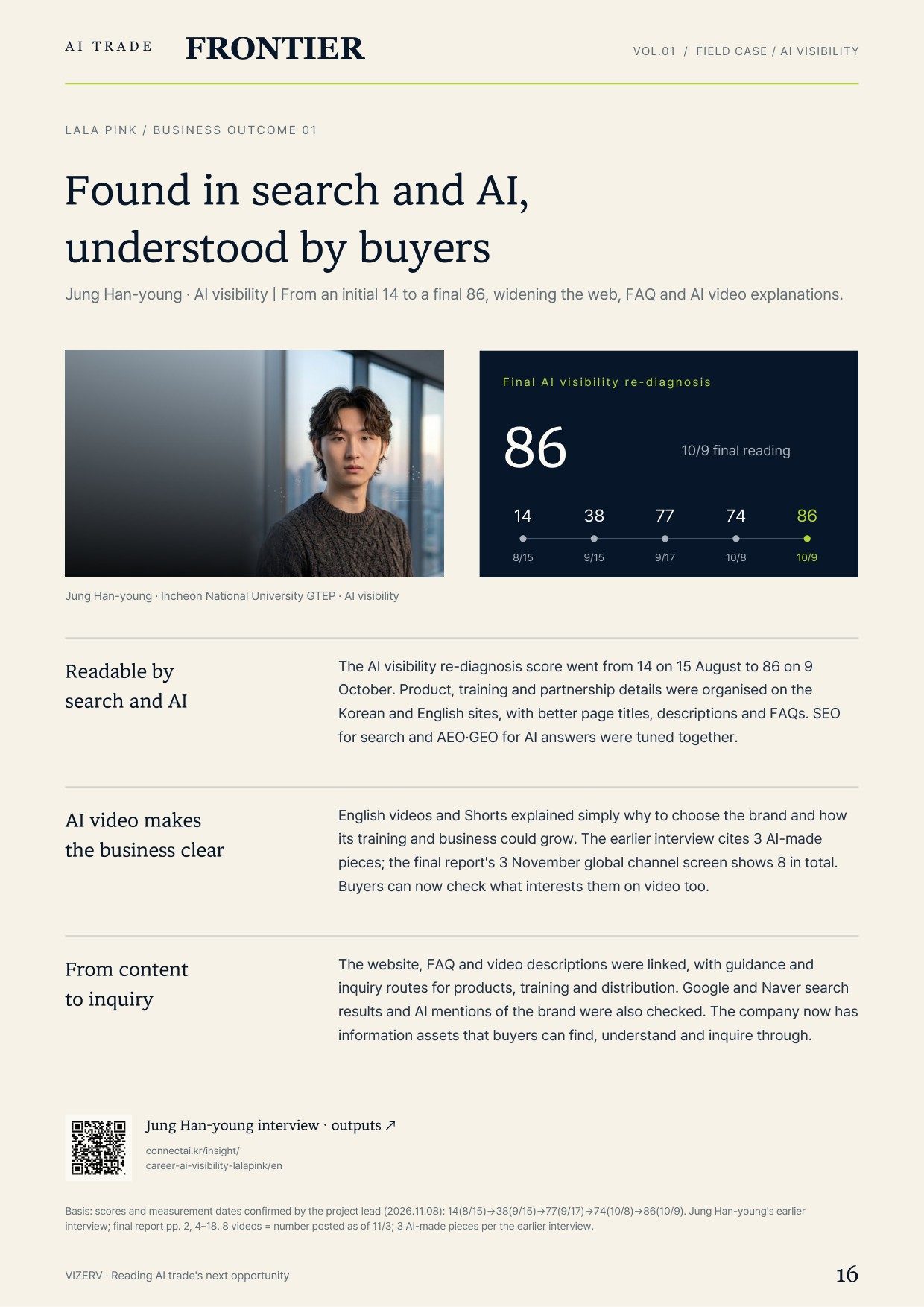
LALA PINK / BUSINESS OUTCOME 01
Found in search and AI,
understood by buyers
Jung Han-young · AI visibility | From an initial 14 to a final 86, widening the web, FAQ and AI video explanations.

Final AI visibility re-diagnosis
- 8610/9 final reading
- 14 → 38 → 77 → 74 → 868/15 · 9/15 · 9/17 · 10/8 · 10/9
Readable by
search and AI
The AI visibility re-diagnosis score went from 14 on 15 August to 86 on 9 October. Product, training and partnership details were organised on the Korean and English sites, with better page titles, descriptions and FAQs. SEO for search and AEO·GEO for AI answers were tuned together.
AI video makes
the business clear
English videos and Shorts explained simply why to choose the brand and how its training and business could grow. The earlier interview cites 3 AI-made pieces; the final report's 3 November global channel screen shows 8 in total. Buyers can now check what interests them on video too.
From content
to inquiry
The website, FAQ and video descriptions were linked, with guidance and inquiry routes for products, training and distribution. Google and Naver search results and AI mentions of the brand were also checked. The company now has information assets that buyers can find, understand and inquire through.
Jung Han-young interview · outputs ↗connectai.kr/insight/career-ai-visibility-lalapink/en
Basis: scores and measurement dates confirmed by the project lead (2026.11.08): 14(8/15)→38(9/15)→77(9/17)→74(10/8)→86(10/9). Jung Han-young's earlier interview; final report pp. 2, 4–18. 8 videos = number posted as of 11/3; 3 AI-made pieces per the earlier interview.
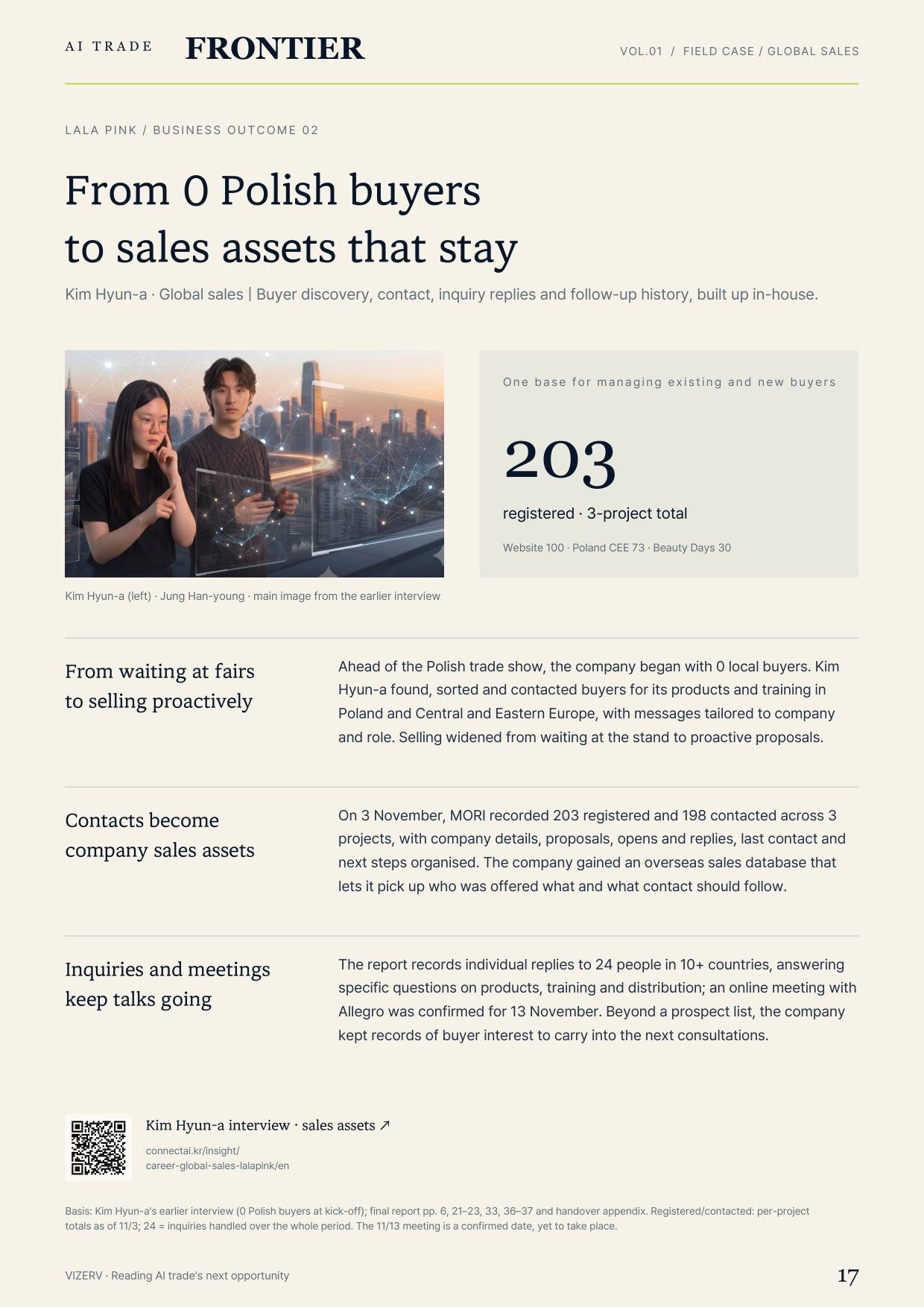
LALA PINK / BUSINESS OUTCOME 02
From 0 Polish buyers
to sales assets that stay
Kim Hyun-a · Global sales | Buyer discovery, contact, inquiry replies and follow-up history, built up in-house.

One base for managing existing and new buyers
- 203registered · 3-project total
Website 100 · Poland CEE 73 · Beauty Days 30
From waiting at fairs
to selling proactively
Ahead of the Polish trade show, the company began with 0 local buyers. Kim Hyun-a found, sorted and contacted buyers for its products and training in Poland and Central and Eastern Europe, with messages tailored to company and role. Selling widened from waiting at the stand to proactive proposals.
Contacts become
company sales assets
On 3 November, MORI recorded 203 registered and 198 contacted across 3 projects, with company details, proposals, opens and replies, last contact and next steps organised. The company gained an overseas sales database that lets it pick up who was offered what and what contact should follow.
Inquiries and meetings
keep talks going
The report records individual replies to 24 people in 10+ countries, answering specific questions on products, training and distribution; an online meeting with Allegro was confirmed for 13 November. Beyond a prospect list, the company kept records of buyer interest to carry into the next consultations.
Kim Hyun-a interview · sales assets ↗connectai.kr/insight/career-global-sales-lalapink/en
Basis: Kim Hyun-a's earlier interview (0 Polish buyers at kick-off); final report pp. 6, 21–23, 33, 36–37 and handover appendix. Registered/contacted: per-project totals as of 11/3; 24 = inquiries handled over the whole period. The 11/13 meeting is a confirmed date, yet to take place.
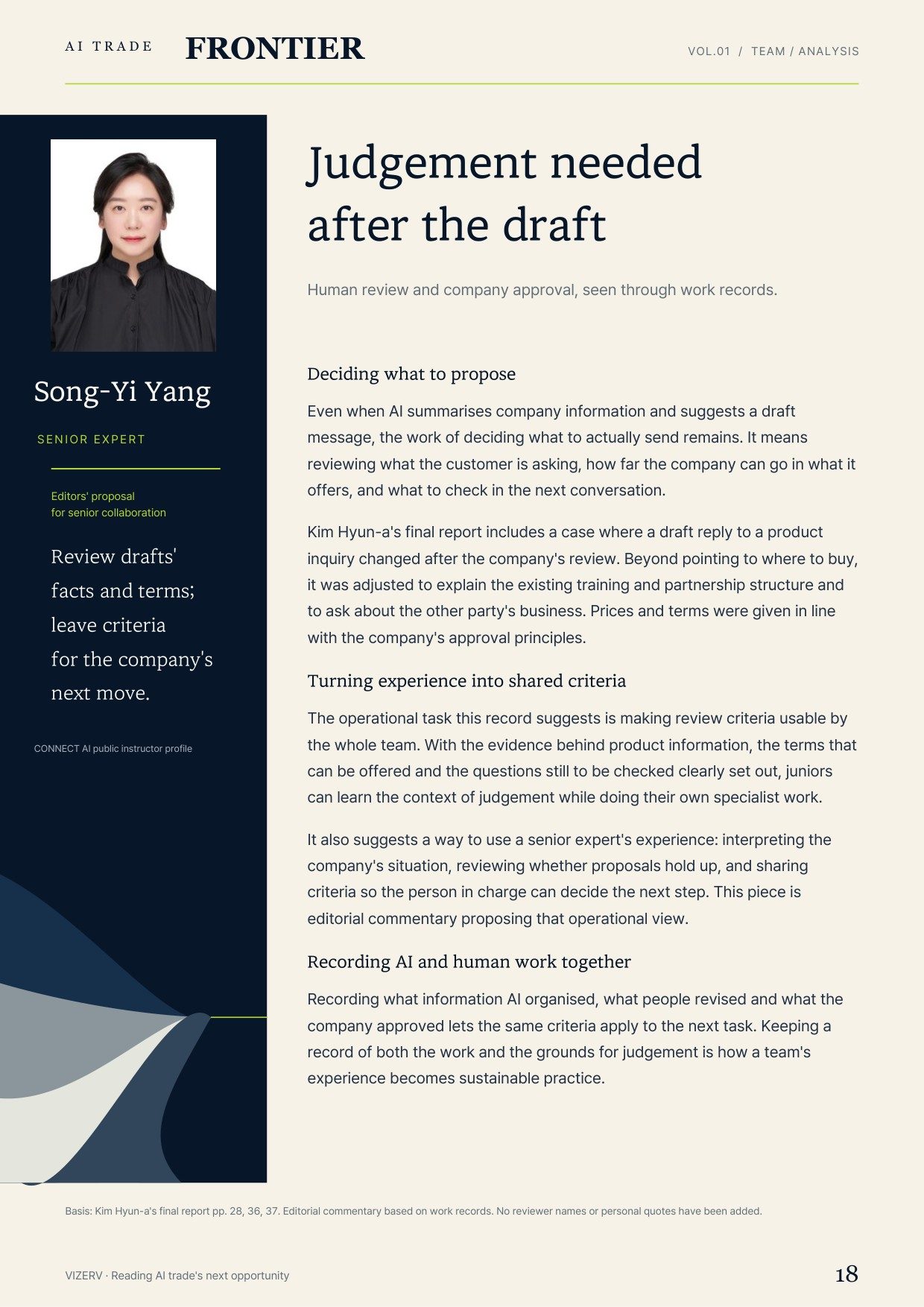
SENIOR EXPERT
Judgement needed
after the draft
Human review and company approval, seen through work records.

Song-Yi Yang
Editors' proposal
for senior collaboration
Review drafts'
facts and terms;
leave criteria
for the company's
next move.
CONNECT AI public instructor profile
Deciding what to propose
Even when AI summarises company information and suggests a draft message, the work of deciding what to actually send remains. It means reviewing what the customer is asking, how far the company can go in what it offers, and what to check in the next conversation.
Kim Hyun-a's final report includes a case where a draft reply to a product inquiry changed after the company's review. Beyond pointing to where to buy, it was adjusted to explain the existing training and partnership structure and to ask about the other party's business. Prices and terms were given in line with the company's approval principles.
Turning experience into shared criteria
The operational task this record suggests is making review criteria usable by the whole team. With the evidence behind product information, the terms that can be offered and the questions still to be checked clearly set out, juniors can learn the context of judgement while doing their own specialist work.
It also suggests a way to use a senior expert's experience: interpreting the company's situation, reviewing whether proposals hold up, and sharing criteria so the person in charge can decide the next step. This piece is editorial commentary proposing that operational view.
Recording AI and human work together
Recording what information AI organised, what people revised and what the company approved lets the same criteria apply to the next task. Keeping a record of both the work and the grounds for judgement is how a team's experience becomes sustainable practice.
Basis: Kim Hyun-a's final report pp. 28, 36, 37. Editorial commentary based on work records. No reviewer names or personal quotes have been added.
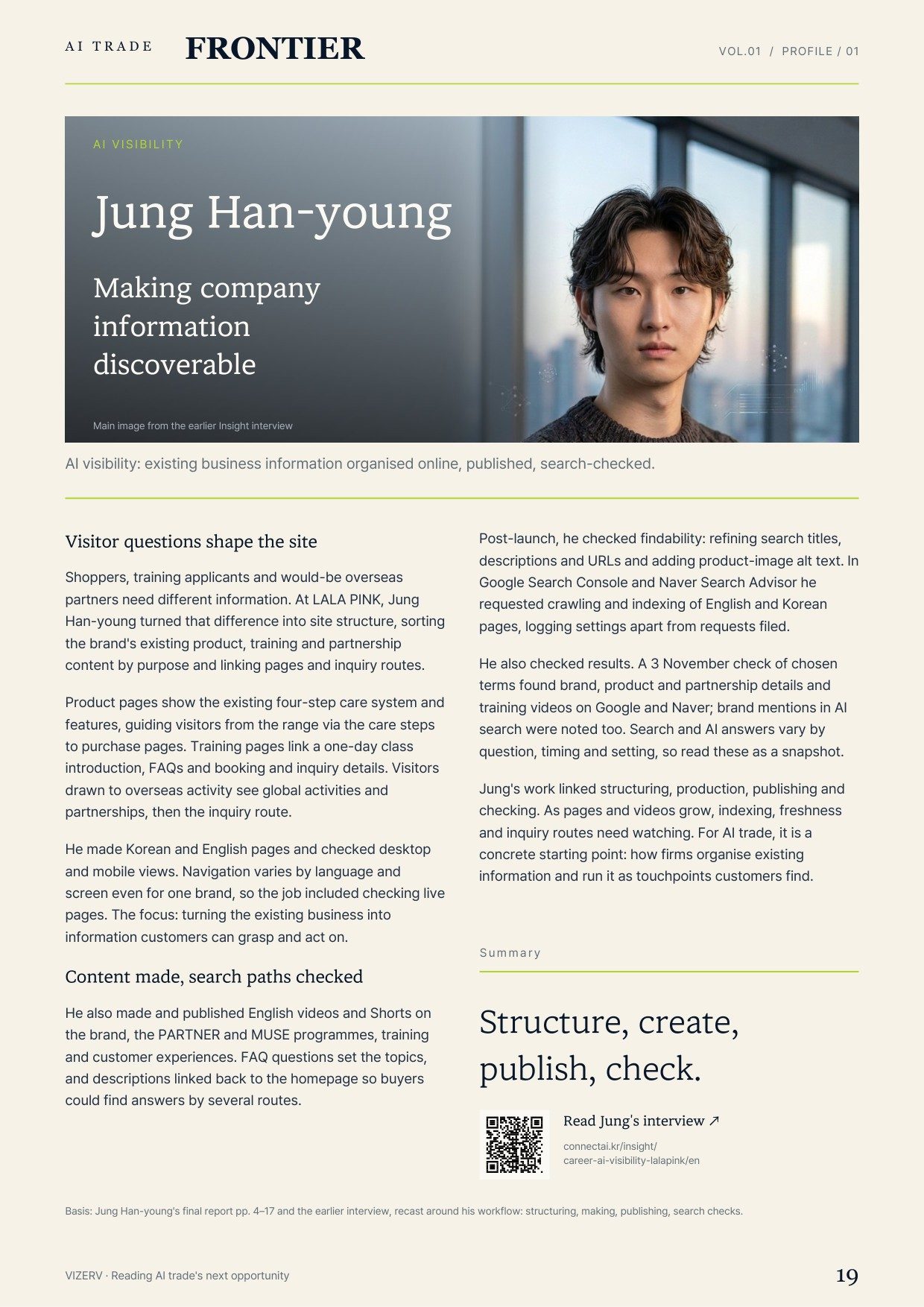
AI VISIBILITY
Jung Han-young
Making company
information
discoverable

AI visibility: existing business information organised online, published, search-checked.
Visitor questions shape the site
Shoppers, training applicants and would-be overseas partners need different information. At LALA PINK, Jung Han-young turned that difference into site structure, sorting the brand's existing product, training and partnership content by purpose and linking pages and inquiry routes.
Product pages show the existing four-step care system and features, guiding visitors from the range via the care steps to purchase pages. Training pages link a one-day class introduction, FAQs and booking and inquiry details. Visitors drawn to overseas activity see global activities and partnerships, then the inquiry route.
He made Korean and English pages and checked desktop and mobile views. Navigation varies by language and screen even for one brand, so the job included checking live pages. The focus: turning the existing business into information customers can grasp and act on.
Content made, search paths checked
He also made and published English videos and Shorts on the brand, the PARTNER and MUSE programmes, training and customer experiences. FAQ questions set the topics, and descriptions linked back to the homepage so buyers could find answers by several routes.
Post-launch, he checked findability: refining search titles, descriptions and URLs and adding product-image alt text. In Google Search Console and Naver Search Advisor he requested crawling and indexing of English and Korean pages, logging settings apart from requests filed.
He also checked results. A 3 November check of chosen terms found brand, product and partnership details and training videos on Google and Naver; brand mentions in AI search were noted too. Search and AI answers vary by question, timing and setting, so read these as a snapshot.
Jung's work linked structuring, production, publishing and checking. As pages and videos grow, indexing, freshness and inquiry routes need watching. For AI trade, it is a concrete starting point: how firms organise existing information and run it as touchpoints customers find.
Summary
Structure, create,
publish, check.
Read Jung's interview ↗connectai.kr/insight/career-ai-visibility-lalapink/en
Basis: Jung Han-young's final report pp. 4–17 and the earlier interview, recast around his workflow: structuring, making, publishing, search checks.
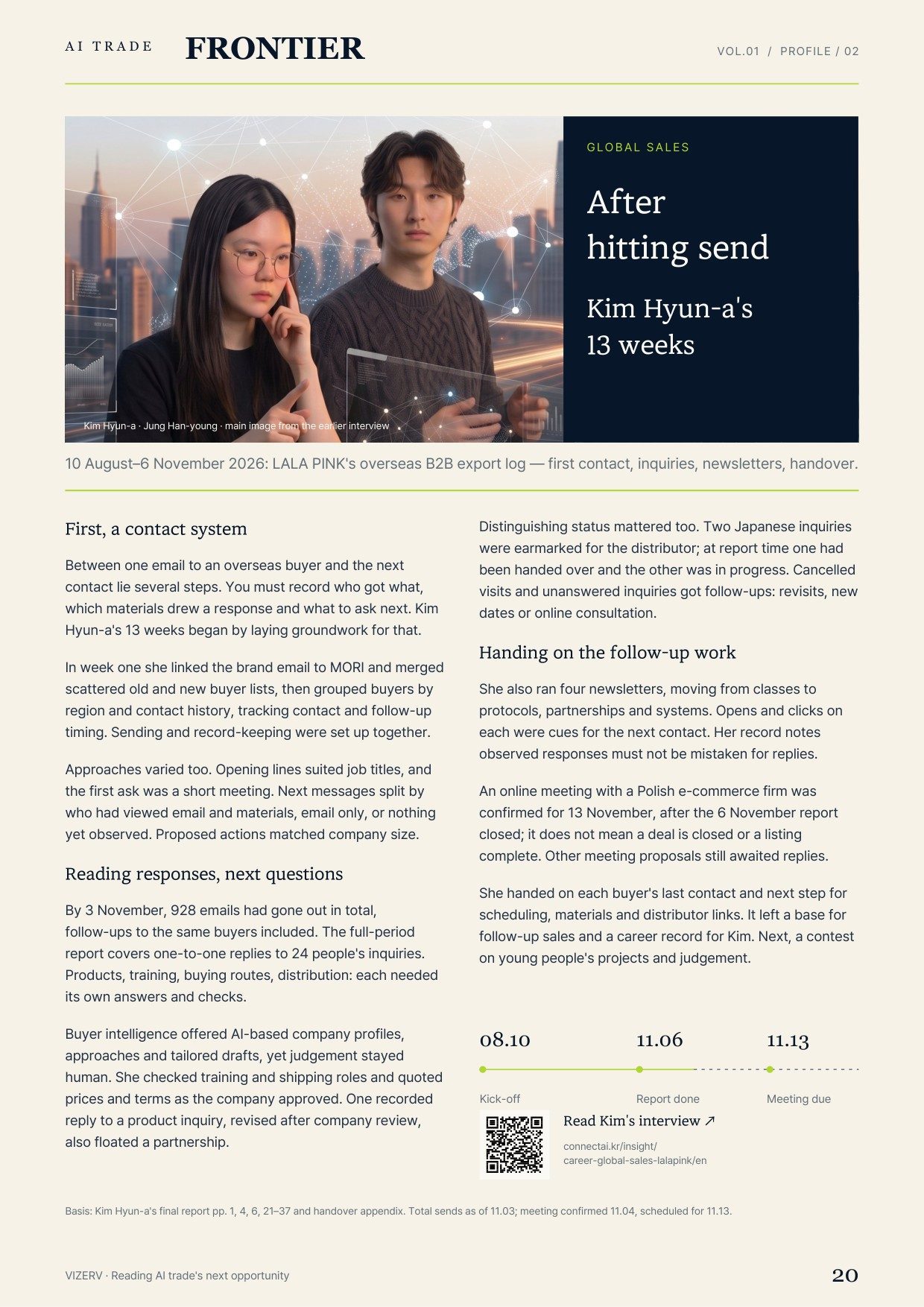
GLOBAL SALES
After
hitting send
Kim Hyun-a's
13 weeks

10 August–6 November 2026: LALA PINK's overseas B2B export log — first contact, inquiries, newsletters, handover.
First, a contact system
Between one email to an overseas buyer and the next contact lie several steps. You must record who got what, which materials drew a response and what to ask next. Kim Hyun-a's 13 weeks began by laying groundwork for that.
In week one she linked the brand email to MORI and merged scattered old and new buyer lists, then grouped buyers by region and contact history, tracking contact and follow-up timing. Sending and record-keeping were set up together.
Approaches varied too. Opening lines suited job titles, and the first ask was a short meeting. Next messages split by who had viewed email and materials, email only, or nothing yet observed. Proposed actions matched company size.
Reading responses, next questions
By 3 November, 928 emails had gone out in total, follow-ups to the same buyers included. The full-period report covers one-to-one replies to 24 people's inquiries. Products, training, buying routes, distribution: each needed its own answers and checks.
Buyer intelligence offered AI-based company profiles, approaches and tailored drafts, yet judgement stayed human. She checked training and shipping roles and quoted prices and terms as the company approved. One recorded reply to a product inquiry, revised after company review, also floated a partnership.
Distinguishing status mattered too. Two Japanese inquiries were earmarked for the distributor; at report time one had been handed over and the other was in progress. Cancelled visits and unanswered inquiries got follow-ups: revisits, new dates or online consultation.
Handing on the follow-up work
She also ran four newsletters, moving from classes to protocols, partnerships and systems. Opens and clicks on each were cues for the next contact. Her record notes observed responses must not be mistaken for replies.
An online meeting with a Polish e-commerce firm was confirmed for 13 November, after the 6 November report closed; it does not mean a deal is closed or a listing complete. Other meeting proposals still awaited replies.
She handed on each buyer's last contact and next step for scheduling, materials and distributor links. It left a base for follow-up sales and a career record for Kim. Next, a contest on young people's projects and judgement.
- 08.10Kick-off
- 11.06Report done
- 11.13Meeting due
Read Kim's interview ↗connectai.kr/insight/career-global-sales-lalapink/en
Basis: Kim Hyun-a's final report pp. 1, 4, 6, 21–37 and handover appendix. Total sends as of 11.03; meeting confirmed 11.04, scheduled for 11.13.
JUNIOR / COMPETITION
Where young people's AI trade
experience becomes expertise
A contest of teams' process and reasoning, from market analysis to proposals and talks.

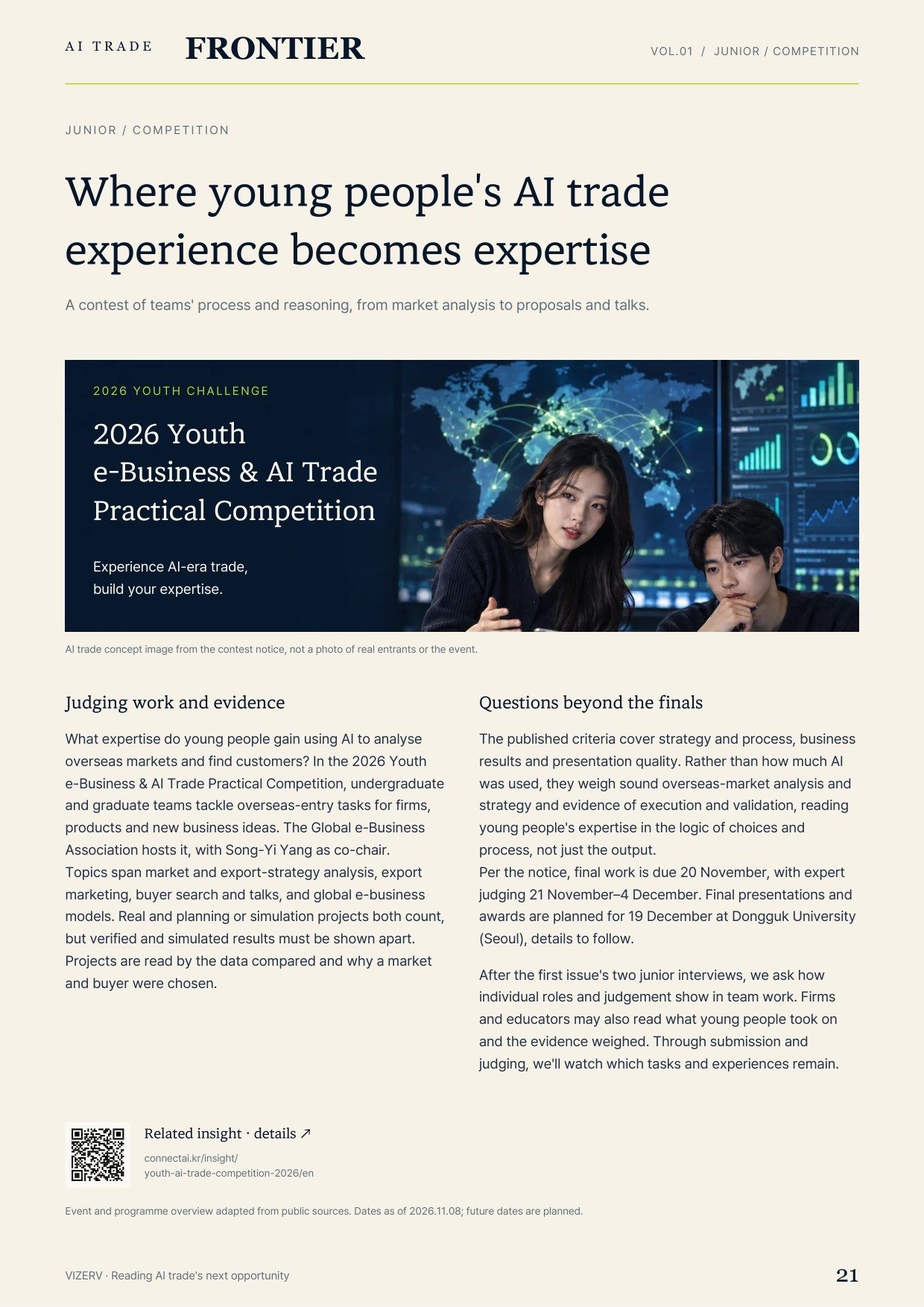
2026 YOUTH CHALLENGE
2026 Youth
e-Business & AI Trade
Practical Competition
Experience AI-era trade,
build your expertise.
Judging work and evidence
What expertise do young people gain using AI to analyse overseas markets and find customers? In the 2026 Youth e-Business & AI Trade Practical Competition, undergraduate and graduate teams tackle overseas-entry tasks for firms, products and new business ideas. The Global e-Business Association hosts it, with Song-Yi Yang as co-chair.
Topics span market and export-strategy analysis, export marketing, buyer search and talks, and global e-business models. Real and planning or simulation projects both count, but verified and simulated results must be shown apart. Projects are read by the data compared and why a market and buyer were chosen.
Questions beyond the finals
The published criteria cover strategy and process, business results and presentation quality. Rather than how much AI was used, they weigh sound overseas-market analysis and strategy and evidence of execution and validation, reading young people's expertise in the logic of choices and process, not just the output.
Per the notice, final work is due 20 November, with expert judging 21 November–4 December. Final presentations and awards are planned for 19 December at Dongguk University (Seoul), details to follow.
After the first issue's two junior interviews, we ask how individual roles and judgement show in team work. Firms and educators may also read what young people took on and the evidence weighed. Through submission and judging, we'll watch which tasks and experiences remain.
Related insight · details ↗connectai.kr/insight/youth-ai-trade-competition-2026/en
Event and programme overview adapted from public sources. Dates as of 2026.11.08; future dates are planned.
SENIOR / GLOBAL
When senior experience
turns into global business
AI and data for finance, industry, trade and consulting careers: the ‘AI Global Business Consultant Programme’.

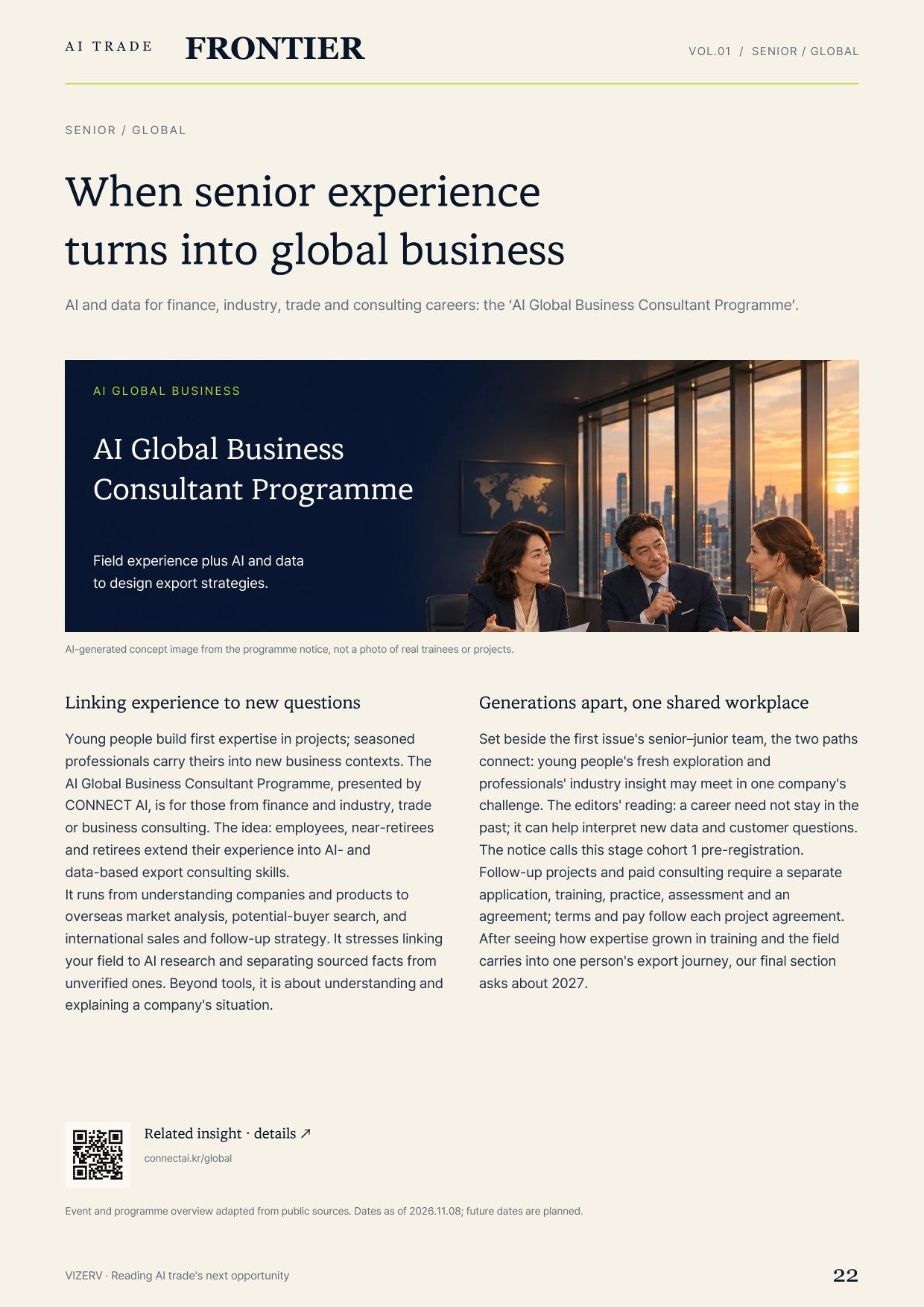
AI GLOBAL BUSINESS
AI Global Business
Consultant Programme
Field experience plus AI and data
to design export strategies.
Linking experience to new questions
Young people build first expertise in projects; seasoned professionals carry theirs into new business contexts. The AI Global Business Consultant Programme, presented by CONNECT AI, is for those from finance and industry, trade or business consulting. The idea: employees, near-retirees and retirees extend their experience into AI- and data-based export consulting skills.
It runs from understanding companies and products to overseas market analysis, potential-buyer search, and international sales and follow-up strategy. It stresses linking your field to AI research and separating sourced facts from unverified ones. Beyond tools, it is about understanding and explaining a company's situation.
Generations apart, one shared workplace
Set beside the first issue's senior–junior team, the two paths connect: young people's fresh exploration and professionals' industry insight may meet in one company's challenge. The editors' reading: a career need not stay in the past; it can help interpret new data and customer questions.
The notice calls this stage cohort 1 pre-registration. Follow-up projects and paid consulting require a separate application, training, practice, assessment and an agreement; terms and pay follow each project agreement. After seeing how expertise grown in training and the field carries into one person's export journey, our final section asks about 2027.
Related insight · details ↗connectai.kr/global
Event and programme overview adapted from public sources. Dates as of 2026.11.08; future dates are planned.
ONE-PERSON AI TRADE / PERSPECTIVE
The solo trader in the AI era
One person's expertise,
customers worldwide
Market research, buyer discovery, MORI and meetings in your own language: one connected export sales journey.
Analysis adapted from the CONNECT AI one-person AI trade insight.
From trading alone to trading connected
'One-person trade' first brings headcount to mind. What the CONNECT AI insight shows instead is a way of connecting export work. It links the information, tools and expert experience needed to start exporting; with them, the company's own team chooses markets, builds buyer relationships and assesses important trade terms.
The journey starts with an export readiness review: products, supply terms, materials and export experience are checked to set priority tasks, and Market Intelligence explores demand, competition, distribution and entry requirements in target markets. BuyerConnect then finds potential buyers whose purchasing needs match the products, reviews their fit and sets out whom to contact and how to propose.
Reading interest, talking in each language
MORI uses DBI (Digital Behavior Intelligence) to weigh buyer interest and trust together, narrowing down whom to talk to first, and mentors proposals and follow-up for each buyer. In video meetings in each side's own language, within the supported languages, the company explains its products and confirms requirements. What is confirmed leads into discussing samples, quotations, quantities, delivery and payment terms.
The company reviews and decides the final trade terms and whether to sign a contract. The discovery, signals, conversation and judgement read across this issue come together in one person's export journey. How far could these connections then move on their own? Next, we ask about trade in 2027.
Readiness review
Interest and trust
Talks in each language
Read the original insight ↗connectai.kr/insight/one-person-ai-trade/en
Editorial adaptation of the CONNECT AI one-person AI trade insight (published 2026.10.22), checked 2026.11.08. Image: capture of the original UI graphic from the CONNECT AI insight.
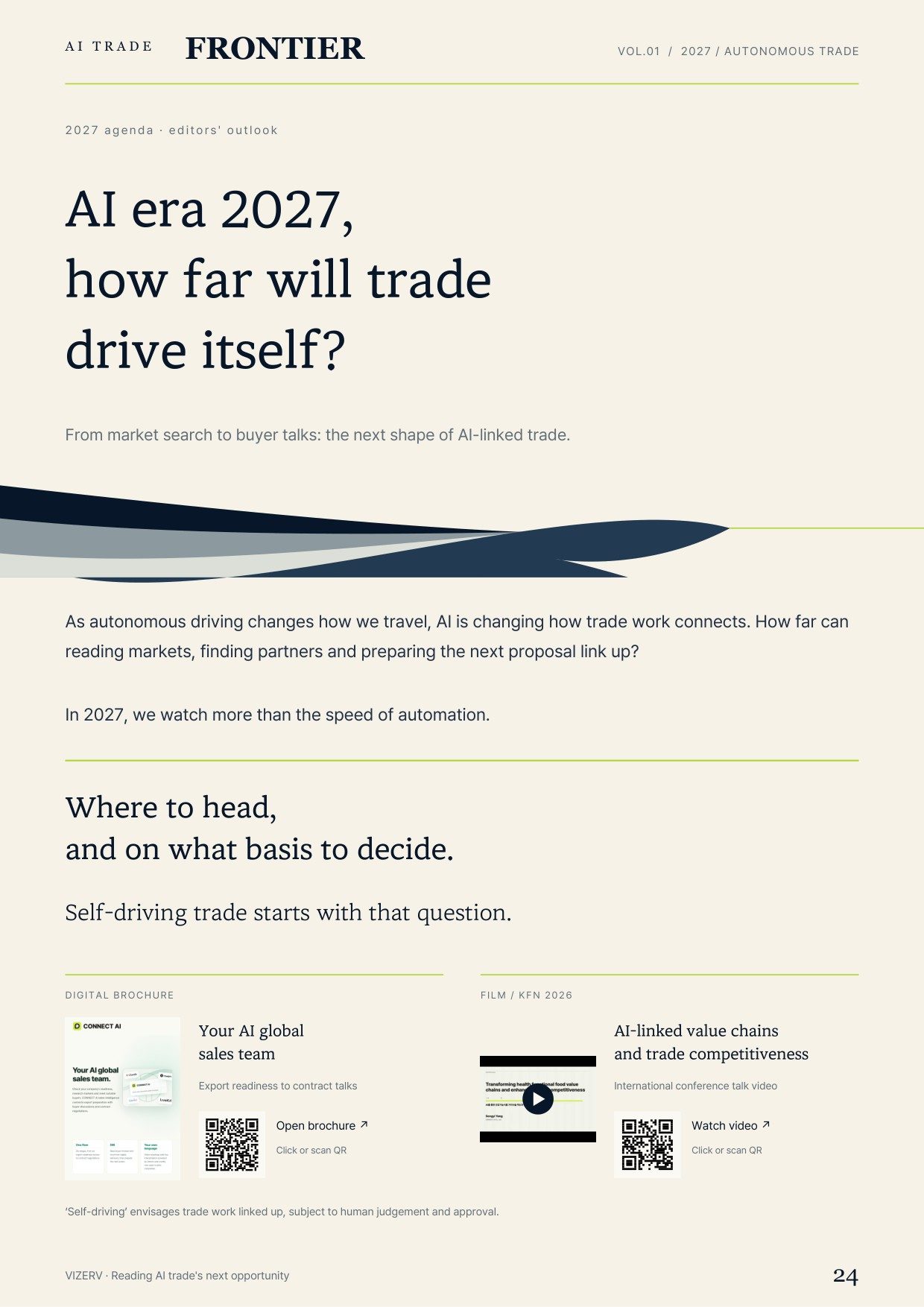
2027 agenda · editors' outlook
AI era 2027,
how far will trade
drive itself?
From market search to buyer talks: the next shape of AI-linked trade.
As autonomous driving changes how we travel, AI is changing how trade work connects. How far can reading markets, finding partners and preparing the next proposal link up?
In 2027, we watch more than the speed of automation.
Where to head,
and on what basis to decide.
Self-driving trade starts with that question.
DIGITAL BROCHURE

Your AI global
sales team
Export readiness to contract talks
FILM / KFN 2026

AI-linked value chains
and trade competitiveness
International conference talk video
‘Self-driving’ envisages trade work linked up, subject to human judgement and approval.
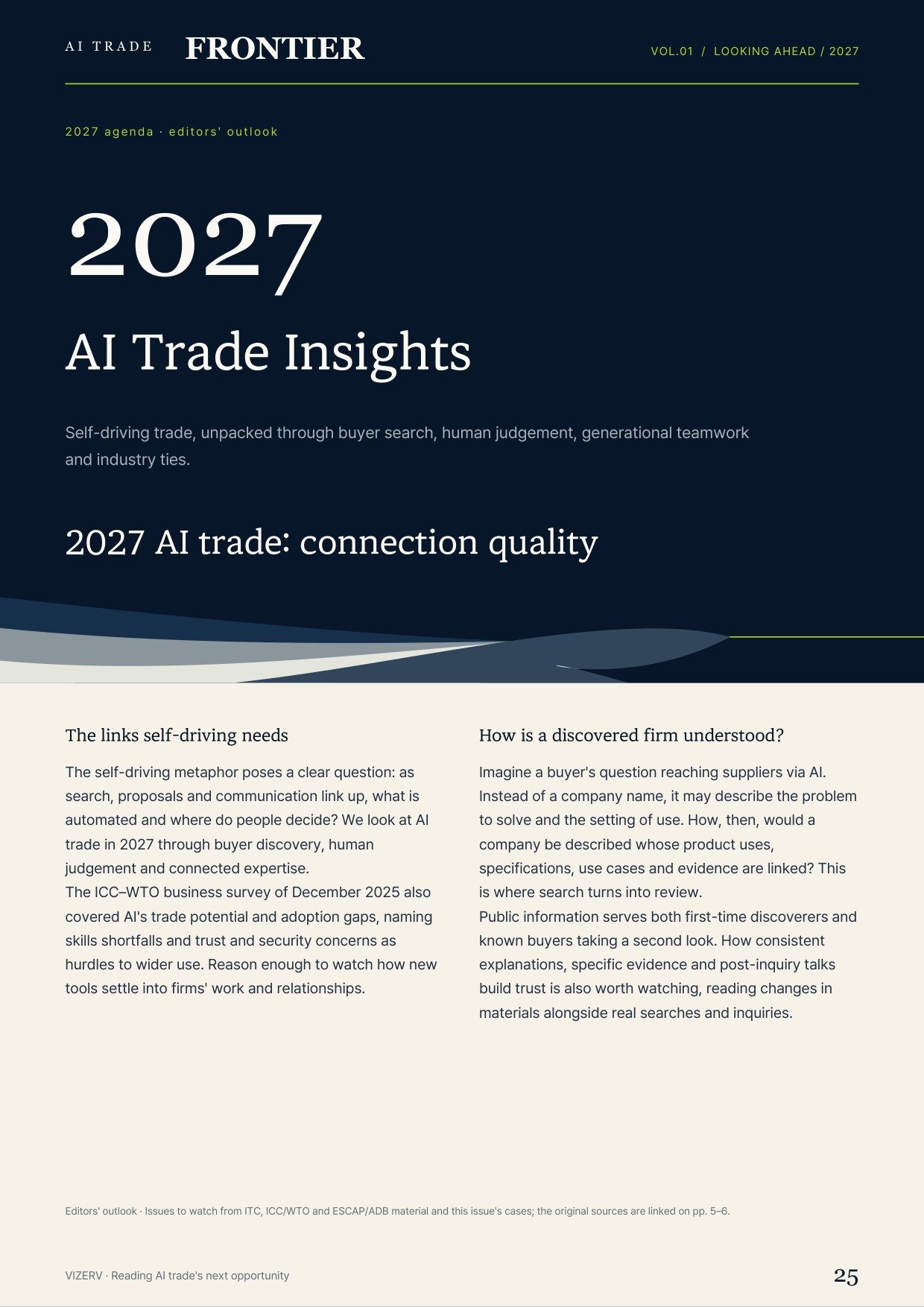
2027 agenda · editors' outlook
2027
AI Trade Insights
Self-driving trade, unpacked through buyer search, human judgement, generational teamwork and industry ties.
2027 AI trade: connection quality
The links self-driving needs
The self-driving metaphor poses a clear question: as search, proposals and communication link up, what is automated and where do people decide? We look at AI trade in 2027 through buyer discovery, human judgement and connected expertise.
The ICC–WTO business survey of December 2025 also covered AI's trade potential and adoption gaps, naming skills shortfalls and trust and security concerns as hurdles to wider use. Reason enough to watch how new tools settle into firms' work and relationships.
How is a discovered firm understood?
Imagine a buyer's question reaching suppliers via AI. Instead of a company name, it may describe the problem to solve and the setting of use. How, then, would a company be described whose product uses, specifications, use cases and evidence are linked? This is where search turns into review.
Public information serves both first-time discoverers and known buyers taking a second look. How consistent explanations, specific evidence and post-inquiry talks build trust is also worth watching, reading changes in materials alongside real searches and inquiries.
Editors' outlook · Issues to watch from ITC, ICC/WTO and ESCAP/ADB material and this issue's cases; the original sources are linked on pp. 5–6.
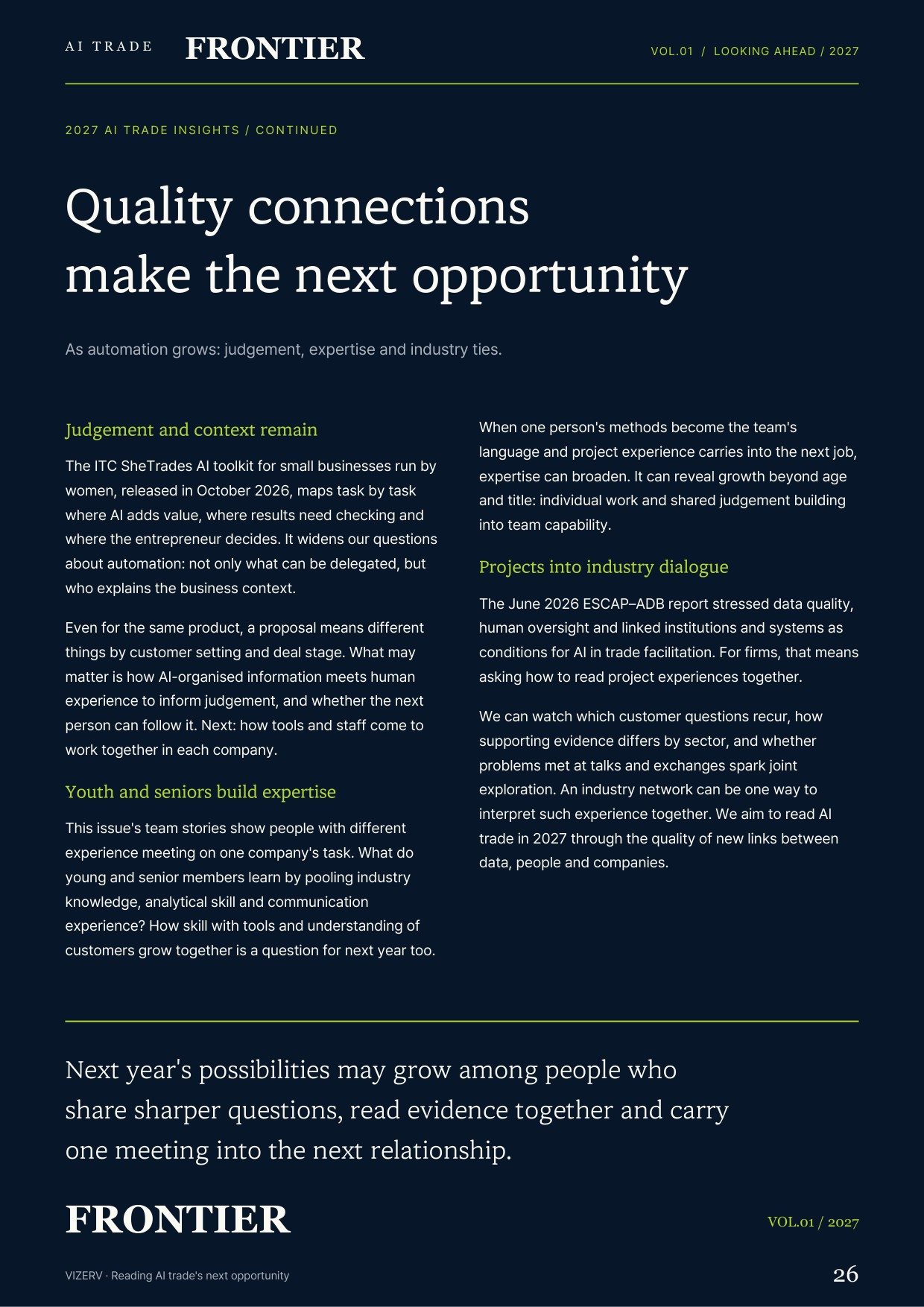
2027 AI TRADE INSIGHTS / CONTINUED
Quality connections
make the next opportunity
As automation grows: judgement, expertise and industry ties.
Judgement and context remain
The ITC SheTrades AI toolkit for small businesses run by women, released in October 2026, maps task by task where AI adds value, where results need checking and where the entrepreneur decides. It widens our questions about automation: not only what can be delegated, but who explains the business context.
Even for the same product, a proposal means different things by customer setting and deal stage. What may matter is how AI-organised information meets human experience to inform judgement, and whether the next person can follow it. Next: how tools and staff come to work together in each company.
Youth and seniors build expertise
This issue's team stories show people with different experience meeting on one company's task. What do young and senior members learn by pooling industry knowledge, analytical skill and communication experience? How skill with tools and understanding of customers grow together is a question for next year too.
When one person's methods become the team's language and project experience carries into the next job, expertise can broaden. It can reveal growth beyond age and title: individual work and shared judgement building into team capability.
Projects into industry dialogue
The June 2026 ESCAP–ADB report stressed data quality, human oversight and linked institutions and systems as conditions for AI in trade facilitation. For firms, that means asking how to read project experiences together.
We can watch which customer questions recur, how supporting evidence differs by sector, and whether problems met at talks and exchanges spark joint exploration. An industry network can be one way to interpret such experience together. We aim to read AI trade in 2027 through the quality of new links between data, people and companies.
Next year's possibilities may grow among people who share sharper questions, read evidence together and carry one meeting into the next relationship.